.jpg)
AI Automation has progressed beyond limited experiments to include essential business processes. Companies are finding AI useful in gathering documents, providing customer service, performing analytics, streamlining internal procedures, and integrating systems.
However, once AI starts to process sensitive information or perform operations in corporate systems, the evaluation criteria fundamentally change.
In addition to successfully completing a pilot project, an AI solution must be safe for use in practice. The issues of security, access control, data handling, human involvement, and monitoring need to be considered.
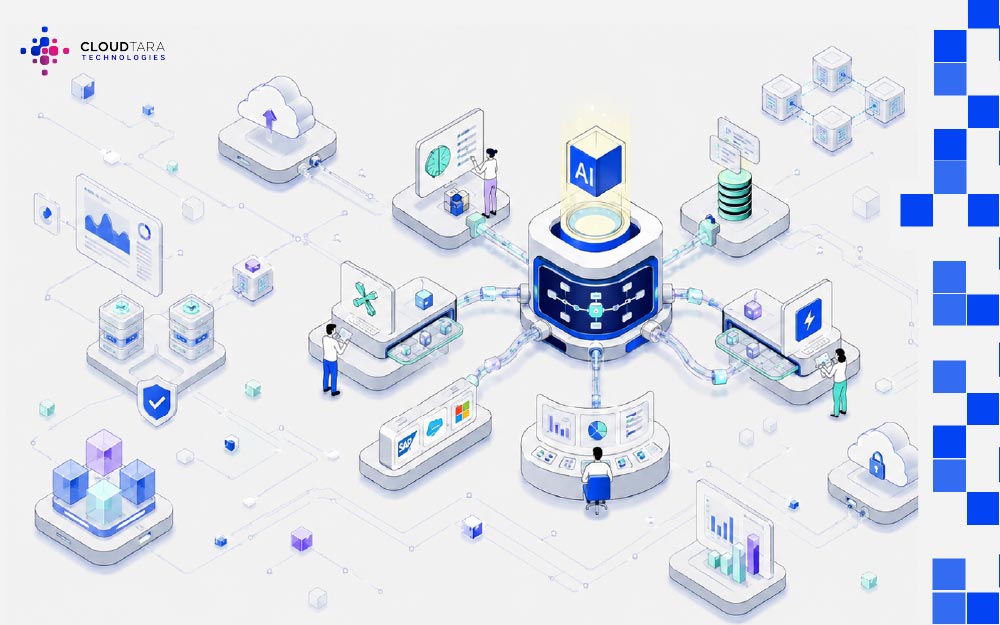
For enterprises, this also means connecting AI with existing workflows and systems rather than treating automation as a standalone solution. CloudTara focuses on this practical approach, helping businesses integrate AI workflow automation into their existing technology environment.
Therefore, when selecting AI Automation Services, one should not only consider the AI model used or the number of processes being automated.
The main question should be:
Is the employed AI automation able to work securely, reliably, and responsibly in an enterprise?
Such inquiries will give a better idea of evaluating Enterprise AI Automation than simply acknowledging the AI model used by a provider.
Artificial intelligence automation services enable processes in organizations by combining features of artificial intelligence with the automation of certain workflows.
Whereas traditional automation typically occurs based on established guidelines, AI automation makes it possible to perform certain tasks that requires individual processing, such as document reading, information understanding, request classification, response development, pattern recognition, and making recommendations.
One instance of artificial intelligence application in financial workflows includes the following steps:
- collecting information from bills
- checking that data against business rules
- matching bills with purchase orders
- marking deviations
- routing approvals
- updating an ERP system
- recording audit information
The key difference is that AI takes part in the actual business process and is not simply separate from it.
This means that several security, access rights, governance, and human controls should be in place.
The Importance of Security in Evaluating AI Solutions
Ensuring security is to be part of the evaluation process and not just an afterthought after the AI-based solution has been adopted.
AI has access to customer and financial data; organizational documents, intelligence on certain processes, and systems. Consequently, the solution may execute actions rather than just provide information.
Therefore, it is important to examine the whole process rather than just the artificial intelligent software.
Data Protection
It should be clear what kind of data does the AI system use.
Ask How does the data come into the system?
Where does the data go for processing?
Is any sensitive material accumulated in the system?
How long does it stay there?
Does the business information process help develop the learning model?
How does the information go under protection before the transmission and accumulation?
The provider should explain how the data goes in a clear way instead of simply claiming that the security system is reliable.
Identity and Access Management
The artificial intelligent program should not gain unlimited access to the information resources of the enterprise without defined permission.
Access should be provided based on strict permission definitions.
For example, the artificial intelligent program distributing the financial report should access financial information but should not be able to edit accounting documents.
That is why it is very important for the evaluation to include the following points:
- Authentication
- Authorization
- Based on roles access
- Using minimum access permissions
- Management of the credentials
- Access regulation
- Distribution of duties
So, the question is not just "what AI is capable of?" it is also about "what it is allowed to do?"
Auditability and Traceability
When the automated workflow executes or assists in an important decision, a company needs to understand what goes on.
The production-ready system should allow for tracking relevant information such as:
- Who initiated the process?
- What data was used?
- What technology was used?
- What actions were performed?
- Where approvals occurred?
- What output was generated?
- What happened afterwards?
Which is especially important when talking about regulated workflows and processes.
7 Criteria for Evaluating the AI Automation Services
The evaluation framework should include more than just demos and feature lists.
1. How well does it work with existing enterprise systems?
AI solutions do not run in isolated fashion.
Your automation might need to integrate with CRM, ERP, HR, finance and accounting, document management, databases, APIs, and in-house applications.
Ask the vendor:
- Which systems can be integrated with?
- How are APIs and connectors secured?
- Will it work with existing infrastructure?
- What will happen in case of integration failure?
- What happens when the operating system changes?
Importance of Integration Capability
Integration capability is essential because automation which can't be integrated into existing business processes stands a risk of creating another layer that is disconnected from other processes.
CloudTara's approach takes a radically different route where it focuses on integrating AI, workflow automation, and the existing enterprise systems, thereby eliminating the need to create a separate layer for automation.
2. What Level of Autonomy Should the System Be Given?
Not all workflows can be given the same level of autonomy.
While some processes can be automated entirely, others may require human validation for approving, modifying, or overriding an action by AI.
The boundaries are, therefore, necessary to be defined.
For instance:
What AI can do:
- Classify incoming requests
- Extract data
- Suggest the next action
- Create a response
Actions which require human approval:
- Approval of financial transactions
- Sending sensitive data
- Changing valuable customer data
- Making big decisions
The main point here is that the human intervention should be based on business risk and not overloading the actual process with approvals.
3. What If AI Fails?
Any AI Automation solution must have a failure management plan.
Ask yourself this question:
What happens when:
- The model yields wrong output
- There is a lack of information needed
- The confidence level is below acceptable
- The API fails to work
- The workflow receives an unexpected input
- The downstream process does not accept the action taken
An optimal deployment should incorporate a series of escalation measures to intervene in cases of excessive failures.
The provider need to also clarify whether or not workflows can stop, retry or escalate the problems to a person.
4. Is it Possible to Control the System in an Operational Mode?
A successful test does not ensure successful introduction of the system into production.
Firms should get insight into how the automation performs through time.
The following features should be sought:
- Monitoring of workflows
- Error tracking
- Monitoring of performance
- Monitoring of usage
- Audit logs
- Exception reports
- Alerts
- Monitoring of versions
The monitoring should be done for both the AI part and the business process it is part of.
5. How Auditing in AI Works
Governance must consist of more than compliance frameworks.
It should stipulate who is in charge of the AI system, who is able to modify it, who keeps an eye on its processes, and who is held accountable in case of failure.
A significant governance model must answer the following questions regarding:
- Business ownership
- Technical ownership
- Security provision
- Risk and compliance matters
- Human supervision
- Modification management
- Incidents management
Governance must also be relevant after the deployment of the AI solution. Both the models and input information may vary as time goes by and so should the mechanisms ensuring safety.
6. The Scalability of AI Solution
An AI system can start with one process and then become a part of many processes which requires a certain level of architecture.
Ask if the vendor will be able to provide:
- Multilevel integration
- Common safeguarding practices
- Shared monitoring systems
- Classification of governance
- Various AI models and means
- Additional processes without installation of a new system
The aim of the AI automation project should be to establish a manageable environment of automation instead of numerous scattered automation solutions.
7. Assessing Business Value
While security is vital, it is also necessary to have measurable business results from the investments made by the organization.
Before implementation, one must determine what success entails.
The metrics to be considered, depending on the nature of the workflow, may include:
- Time to process
- Reduction of manual input
- Error rates
- Cost per transaction
- Duration of the workflow
- Rate of exceptions
- Response time
- Level of productivity
This ensures AI Automation succeeds in differentiating itself from other technology initiatives that don't have specific business value.
Potential warning signs during the selection of an AI Automation vendor
Some red flags can be overlooked while evaluating a vendor.
"We can automate everything"
Corporate functions vary in terms of their risk profiles and authorization procedures.
The vendor that treats every process like a perfect candidate for full automation does not seem to take the business environment into consideration.
Security is explained in generic terms.
Terms like "enterprise security" are insufficient.
Inquire about the specifics of the data processing, access management, auditing, monitoring, and responding to incidents.
The Demonstration Conceals Your True Systems
An elaborate demonstration can mask the difficulties posed by integration.
Analyze the technology in relation to the systems, data, rights, and exceptions available in your system.
No Indication of Human Intervention
If the supplier is unable to indicate when a real person assumes control, this means that the limits of automation were not set.
The Process Forms Another IT Island
In this case, every new operation requires separate software, connection, security model, and monitoring.
For Safe IA Automation It Is Necessary to Have the Right Operating System
The technology per se is not enough to make Safe IA Automation work.
Companies need an operational system that outlines how to adopt, monitor, and change automated processes based on AI.
AI Groups
Handle model selection, assessment, efficiency, and unique AI-associated dangers.
Process holders
Oversee whether the machine still achieves the desired business outcome.
This aspect of attention becomes more relevant as AI is being used for more than just help employees but also for actions within the enterprise processes.
CloudTara has a product-oriented attitude concerning AI and process transformation, using AI superiority, automation, and enterprise systems while focusing on scalability and cost effectiveness.
How to Choose an AI Automation Service Provider
Before signing a deal, ensure you go through evaluation process in detail and in addition to the sales show.
Utilize a real business process and ask for a real demonstration.
Step 1: Choose a Real Process
Choose a process with tangible business value and identified pain points.
Make sure not to focus on picking a process only for the sake of an impressive demonstration.
A decent option has good volume of regular tasks, defined process boundaries, and measurable time or monetary loss factors in the process. It should be important enough to allow investments but not too significant and crucial for the business that the risk is too high.
Step 2: Data and Systems Mapping
This reveals the actual complexity of the implementation.
This also gives security and IT teams something to work with instead of simply asking if the AI service in question is, in fact, "secure."
Step 3: Establish Boundaries of Automation
Determine what can be done autonomously by AI and where human approval is needed.
These boundaries must take into consideration the risk associated with the workflow.
For example, unless complex permissioning is at stake, extracting data from a document can be performed with hardly any human involvement. On the other hand, approving a high-value transaction would definitely necessitate a human checkpoint.
Step 4: Check Fail Cases
Do not only check the happy path but rather ask the provider to show what happens in case of missing data, failed integration, uncertain results, or refused approval.
Ask the provider how the failure is recorded and how to continue the process afterward.
Step 5: Set Production Metrics
Agree on how implementation will be evaluated after launch.
A successful launch should utilize different performance and business measures and not be only seen as an implementation milestone.
Make sure to review the performance and see what adjustments are needed after the launch.
What to Ask Before Choosing AI Automation Services
Having a structured set of questions can make comparisons between AI automation providers much more useful. Instead of focusing only on features, enterprises should evaluate how the service will fit into their existing technology, workflows, security requirements, and operating model.
Security and Data
- Which enterprise data will be accessed within the workflow?
- Where is this data processed and stored?
- What measures protect sensitive information?
- How is authorized access managed?
- Can access be restricted based on user roles and workflow requirements?
Workflow and Integration
- Which systems will the automation interact with?
- How are integrations implemented and maintained?
- Can the workflow support human approvals and exceptions?
- What happens when a connected system is unavailable?
- Can the automation work with our existing technology instead of requiring a completely new environment?
AI and Governance
- Which AI models or services are being used?
- Can the model or underlying provider be changed when business requirements evolve?
- How are AI outputs evaluated?
- What happens when the system is uncertain?
- Who is responsible for ongoing monitoring, governance, and changes?
Operations
- How is the workflow monitored after deployment?
- What audit information is available?
- How are failures and exceptions handled?
- What support is provided once the system is in production?
- How easily can additional workflows be introduced without creating unnecessary complexity?
Business Value
- Which business metric is expected to improve?
- How will that improvement be measured?
- What are the ongoing operational costs?
- What additional costs could appear as usage and workflows scale?
CloudTara approaches these questions from an enterprise workflow perspective, combining AI, workflow automation, integrations, and modernization around existing business requirements. Its AI and Data Services include workflow automation, AI strategy, production-ready AI solutions, agentic AI-driven automation, and ongoing AI support.
This is important because selecting an AI Automation Service is not simply about finding a platform with the longest feature list. The service needs to work with the systems, people, controls, and processes that already exist inside the enterprise.
The key question therefore shifts from:
“What capabilities does this AI solution have?”
to:
“What can this AI safely and reliably do inside our business?”
That change also provides a more practical way to assess Enterprise AI Automation. Instead of evaluating tools in isolation, decision-makers can evaluate the complete workflow, including its data, integrations, permissions, human checkpoints, governance, and expected business impact.
For Business Automation more broadly, the objective should be similar: streamline work without creating uncontrolled dependencies, unclear ownership, or additional security risks.
.jpg)
.jpg)
.jpg)