Enterprise automation is advancing to systems with capabilities far beyond simply following rules. The future of automation utilizes agents based on goal-directed artificial intelligence (AI), enabling systems to comprehend the context, formulate plans, coordinate with other systems, and change with the altered conditions.
Given this change, creating new workflows based on agents became a priority. Businesses continuing to put in place rigid automation into already outdated workflows risk creating quicker ways of performing tasks while keeping the same slow, fragmented, and manually dependent workflows.
The possibilities are enormous. Boston Consulting Group suggests that AI agents can significantly decrease repetitive tasks performed by employees (by 25%–40%) and speed up business processes (by 30%–50%). Gartner predicts that around 40% of corporate applications will have AI agents by 2026.
This possibility brings not only automation of different tasks but also redesigning the process of achieving results.
What Is Agentic Workflow Reimagination?
Agentic workflow reimagining entails a comprehensive overhaul of the functioning of processes in an organization by using independently operating intelligent agents, interconnected systems, and human control.
Regarding traditional automation, there is a series of steps. Agentic workflows take a starting point as an idea and identify the most desirable actions to take based on the data available, changing circumstances, and intermediate outcomes.
To illustrate, for instance, an ordinary process automation program can transfer invoice data into an ERP system. On the contrary, an agentic procurement workflow can not only transfer invoice details into an ERP system but also hear what is missing in the documentation and look for the related purchase order to validate the contract, thus making decisions about escalated approvals.
The main difference in agentic workflows is intelligence and flexibility. Rather than implementing only one process, agentic workflow reimagination involves the transformation of a system completely devoted to achieving a business goal.
From Rule-Based Scripts to Goal-Driven AI Agents
Enterprise automation has progressed through several stages. Scripts were the earliest form, designed to execute fixed commands within a single application. They worked mainly with structured data and required people to define every step, condition, and response.
Robotic Process Automation (RPA) expanded automation across multiple predefined interfaces. It enabled businesses to automate repetitive, rule-based processes using structured and standardized data. While RPA could make basic decisions, it typically routed unexpected situations to people for resolution.
Generative AI introduced the ability to interpret, summarize, and create unstructured content. This allowed automation to work with documents, emails, conversations, and other information that traditional scripts and RPA systems found difficult to process.
Agentic AI takes this progression further by working towards defined goals. Rather than following a fixed sequence, an AI agent can assess the context, plan its next steps, use approved tools, and adjust its approach based on results. When conditions change, it can investigate the issue, retry an action, choose another route, or escalate the matter to a person.
Agentic AI can also coordinate tasks across approved systems while working with both structured and unstructured data. Human involvement shifts from designing every step to establishing boundaries, governing risk, and reviewing high-impact decisions.
However, agentic AI does not mean giving software complete freedom. Enterprise AI agents operate within approval limits, compliance requirements, security controls, and established business rules.
The distinctions of agentic AI include:
- Independence: They act without instructions for every single step.
- Goals: They focus on a result rather than just one task.
- Flexibility: They adapt their plans based on conditions or outcomes.
- Decision-making capabilities: They process information before deciding to proceed.
- Manipulation: They use the enterprise systems in their work.
- Cooperation: Several specialized agents can work towards the same goal.
Core Components That Power Agentic Workflows
There are various types of agents involved in an agentic workflow:
- Data agents obtain, cleanse, verify, and connect data within trusted business systems
- Task agents execute pre-established operations, e.g., producing reports, modifying records, or scheduling tasks
- Decision agents analyze collected data, business rules, and level of confidence in making a decision or recommendation
- Coordination agents divide big objectives into tasks and allocate them to the agents
- Communication agents share updates, seek the missing information, and provide results through reliable channels
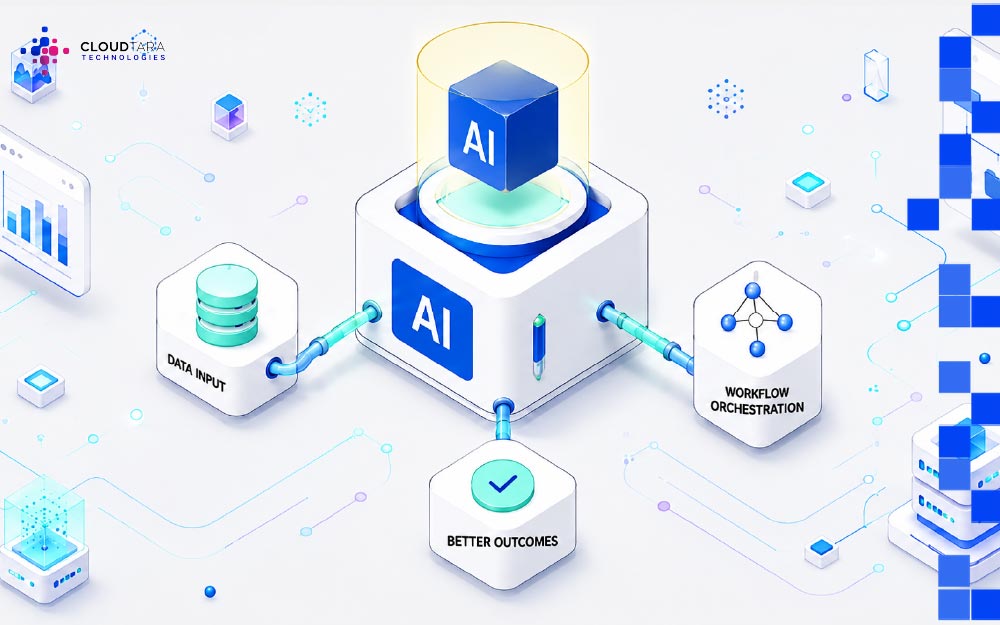
Agents should rely on an orchestration layer, which governs workflow status, calls for tools, permissions granted, retries made, and requires human approvals. They may also apply short-term memory to the current activity and govern long-term memory to a historical background.
Why Is Enterprise Automation Needed?
Traditional automation has made many repetitive processes easier, but it has limitations when the work is unpredictable. Many enterprise workflows still include searching manually, obtaining approvals by means of emails, having fragmented data, and having exceptions that cannot be solved according to set rules. Many employees have to go from one application to another just in order to get enough information for making one decision.
According to the study by the Boston Consulting Group, AI agents are able to reduce the share of low-value work by 25-40%, which means that so many repetitive tasks and information processing are still part of the enterprise operations.
Three major problems occur:
- Dispersed enterprise systems
Customer details might be present in a CRM, pricing rules in ERP software, documents in some kind of document management system, and operational information in a separate database. Classical bots can be able to move pieces of data between systems, but they hit obstacles when it comes to making sense of the overall context.
- Long decision time
The workflow may come to a standstill as soon as an employee has to process a request for information, a request for a go-ahead, or proceed with an exception. Thus, automating a specific task does not help much when the whole decision-making process still takes days.
- Risks of compliance and accountability
Disconnected automation can make it difficult to explain why something was done and which information served that purpose. With further automation becoming more autonomous, it is important to have clear records of decisions made and accountable ownership of this information.
Businesses can eliminate these drawbacks by means of enterprise workflow automation solutions developed with the whole flow in mind instead of single tasks.
Key Ways Agentic AI Reimagines Enterprise Workflows
- Replacing Fixed Automation with Flexible Intelligence
Standard business processes can take only those paths predetermined by designers. When a variable changes, for instance, an integration fails or an unexpected variable occurs, the process stops.
An artificial intelligence-based process can analyze the new situation and pick a different way forward.
Take, for example, a supply chain process where an unforeseen delay in the service of a supplier occurs. The conventional process would generate a warning. The artificial intelligence-powered process would recognize orders affected by the delay, try to identify other suppliers, see costs and delivery conditions, update its forecasts, and propose the best option.
Low-risk adjustments could be performed automatically, while other types of decisions that entail spending large sums, signing contracts, or making customer commitments will be forwarded to an authorized person.
Such adaptability of processes results in improved automation without diminishing human accountability.
- Managing Workflows Across the Entire System
In many cases, robotic process automation is applied to automate a single activity in a specific system or automate two systems, where the human mediator is still involved in the overall process.
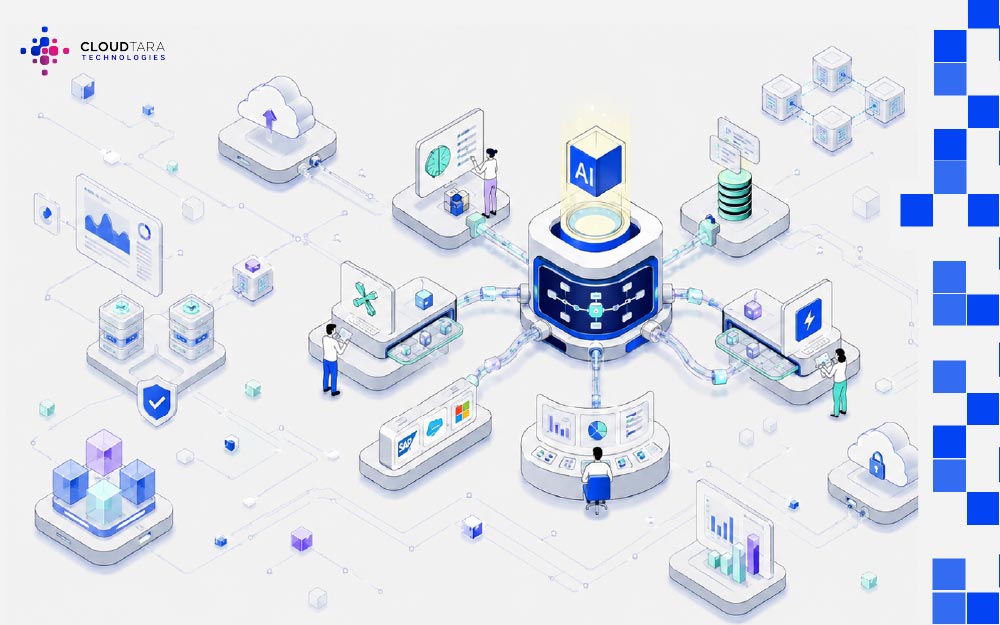
However, modern AI agents can operate in the following systems:
- Enterprise resource planning
- Customer relationship management
- Cloud applications
- Data storage
- Document repositories
- Ticketing systems
- Communication tools
Indeed, the agent assigned the research to the data agent, the validation to the decision agent,
and recording the updates to the task agent. In this case, the multi-agent approach helps the specialized agents to work collaboratively to achieve the desired goal.
- Facilitating quicker and smarter enterprise decision-making
Agentic workflows accelerate decision-making procedures by integrating the stages of information gathering, processing, and acting into one cohesive cycle.
Rather than waiting for a manual employee to collect data, an agent should pull together the necessary context, discover patterns, and give suggestions based on evidence.
JPMorgan serves as a good case study of deployed enterprise AI in practice, but there is a misconception of “450 active agentic use cases being executed every day.” Reports from Reuters indicate the bank has pinpointed about 450 potential AI initiatives while its GenAI toolkit has been made available to more than 200,000 of its employees. The bank attributed approximately $1.5 billion in benefits to its AI activities aimed at fraud prevention, trading, credit decisions and operational efficiency.
The key takeaway should not be counting the number of agents but rather linking each deployment to business outputs like faster decisions, decreased errors and improved customer experience.
Thus, organizations engaged in implementing intelligent workflow automation for enterprises should take account of the whole decision cycle instead of only looking at the speed of one AI task.
- Dealing with Exceptions Without Interrupting Workflow
Exceptions are where traditional automation often falters. An absent document, conflicting record, or unavailable system may send work back to the worker.
An agentic workflow can take multiple pre-approved actions without escalation:
- Search an alternate source of information
- Request the missing information
- Retry the failed system call
- Validate the contradictory records
- Take an alternate pre-approved workflow path
- Transfer the case to the right specialist with a summary
The workflow becomes better at navigating uncertainty while still escalating decisions that it cannot make on its own.
- Constantly Enhancing Workflow Operations
Agentic systems provide extensive data about where they went, what they used, and what went wrong.
Based on this information, teams can determine:
- Repeated failures in workflow
- Reasons for escalation issues
- Integration issues
- Slow points of approval
- Most overridden suggestions
- Instructions leading to varying outcomes
Improvements cannot rely on uncontrolled self-learning. The changes in prompts, policies, models, or permissions need to be assessed and controlled through an official release process.
Real-World Enterprise Use Cases Worth Knowing
- Finance: Invoice Processing and Fraud Detection
Financial duties involve collecting invoices, verifying POs, confirming contracts, finding discrepancies,s and generating exceptions for review. In fraud detection, agents can compile transactional records, analyze account activity along with policies to deliver prioritized exceptions along with supporting evidence.
Workflows of this nature can reduce manual efforts while retaining human influence over payment authorizations and risky actions.
- Manufacturing: Design and Testing
Ford has used artificial intelligence systems to speed up engineering modelling that underpins vehicle design. For instance, an AI-based simulation process that usually takes over 15 hours to complete can deliver results in about 10 seconds, thus demonstrating how AI can drastically shorten such testing phases.
A much greater opportunity arises from the fact that the inputs to the design may be connected with simulation tools, engineering requirements, and approval procedures. Engineers will then be able to make faster predictions while remaining in charge of quality and safety.
- Customer Operations: AI-Assisted Service
Klarna disclosed that its AI agent performed the equivalent of what 853 full-time agents could have done, and it saved the company $60 million. The company realized the value of keeping people around for complicated cases and not simply aiming to replace the workforce completely.
One of the service processes enables the AI agent to answer routine requests, get customers’ account history, and direct complex cases to the company’s staff without making customers restart the second part of their interaction.
These cases illustrate the way enterprise-level AI agents operate; it’s important to note that their success is not universally applicable.
Governance, Trust and Human Oversight in Agentic AI
It is impossible to build trust after implementation.
In PwC’s survey conducted in 2025, 28% of executives stated that trust is among their top three obstacles when it comes to using AI agents. It's worth mentioning that trust is the highest in data analysis (38%) as compared to lower numbers for financial transactions (20%) and autonomous employee interaction (22%).
- Audit trails
Businesses must have the ability to identify the agent who acted, the time when it acted, what tools were used, and what results were achieved by that action.
- Decision logging
High-impact decisions must incorporate appropriate inputs, policy controls, levels of assurance, as well as reasons for escalation or execution of those decisions.
- Human-in-the-loop checkpoints
Approval of all decisions related to financial commitments, employment, safety matters, legal rights, regulatory obligations, and significant impact on customers must be performed by people.
- Access controls
Every agent should only access systems, information, and activities necessary for carrying out its role, i.e., access must be based on identity, controllable, and revocable.
- Compliance guardrails
Deterministic rules must stop actions that are not permitted, check whether needed conditions are satisfied, and stop conducting actions if mandatory information is absent.
- Continuous monitoring
Organizations must monitor tool failures, unsupported outputs, compliance breaches, human interferences, and performance changes in real time.
Governance must relate to the level of risk.
How to Start Your Agentic Workflow Transformation?
1. Audit Current Workflows for Agentic Readiness
Create a chart for every workflow that goes from the first task to the last result. Highlight processes with:
- Long lists of unorganized files
- A lot of human involvement
- Several roads coming to the decision
- Numerous changes from one system to another
- High exception rate
- Slow research and approval steps
- A sizeable amount of operational expenses
It is best to ask, “Which workflow would be better if using agents?”
2. Prioritize High-Complexity, High-Value Processes
Pick a business process that can benefit from being adaptable. The process must have a clear workflow owner, have enough data available, and process enough transactions to show its effectiveness.
Determine the benchmark metrics to be obtained before the changes. These metrics are:
- Average processing time
- Average cost incurred per case
- Error and rework rates
- Cases getting escalated
- Rate of straight-through processing
- Work done by employees
- Customer satisfaction
3. Run a Contained Pilot With Clear KPIs
Capitalize on the initial implementation of the project by piloting it on a defined workflow, audience, or category of transactions. Start by having the agent suggest possible actions or generate results to be considered.
Conduct experiments by trying actions in typical, extreme, incomplete, contradictory, unavailable, or wrongly specified cases. Progressively increase the level of independence for the system only after gaining sufficient confidence in its performance within the limits set.
4. Scale With Governance Built In
As soon as the pilot exhibits value, it is necessary to standardize reusable components:
- Enterprise connectors
- Identity and access management
- Patterns of human approval
- Frameworks for evaluation
- Monitoring dashboards
- Audit and incident response protocols
The scale should enhance effectuation patterns rather than just increase the number of agents.
CloudTara helps companies find the most profitable use cases for AI technology, prepare a viable business model, and build the way from the pilot phase to production. Companies can set off on their journey toward agentic AI with one simple use case.
The Future of Enterprise Automation Is Already Here
The concept of agentic workflow reimagination is not just a dream of modern automation. In fact, AI agents have already started making their way into enterprise applications and being used across multiple areas of customer operations, finance, IT, engineering, and supply chain.
According to MarketsandMarkets research, the global market for AI agents was valued at $7.84 billion in 2025 and is expected to grow to $52.62 billion by 2030, which means it will experience a compound annual growth rate of close to 46.3% over this period.
However, a growing market is not synonymous with business value. It is those enterprises that will implement the right workflows, support decision-making with reliable enterprise data, and make accurate business measurements that will gain the advantage over their competitors.
Agentic workflow reimagination framework completely changes the automation question from “What task can be repeated by software?” to “How should this result be achieved?”
CloudTara employs a unique combination of product thinking, enterprise intelligence, and AI engineering to help organizations create agentic workflow implementation strategies.
.jpg)
.jpg)