.jpg)
AI Workflow Automation is a useful technique for organizations to minimize manual intervention, streamline their workflow, and integrate systems. However, with more teams implementing AI Automation, a new issue arises – there can be too many tools performing largely similar tasks.
It is possible that one team implements an AI solution for customer service, while another deploys an automation tool in finance, and the IT department creates its own AI workflows. Each project brings its own value, but in practice, if solutions are operated separately from each other, a company may experience significant complications, such as disintegration of systems, reinstallation of software, higher costs, and unsolved issues.
This is the essence of the problem associated with tools overload.
The person in charge of a business's operations should not think only about the places where AI can be implemented but also about how to apply AI Workflow Automation to make processes much easier without adding extra technical issues.
What Is Tool Sprawl in AI Workflow Automation?
Tool sprawl arises from an organization continuously adding software, applications, automation platforms, and integrations with no particular strategy for its usage.
Tool sprawl can start out innocently enough.
A team in a business works out a tool that solves a certain problem. Another team does the same thing. After some time, it might happen that a few platforms perform the same functions as well or provide connections to the same enterprise systems.
Warning signs include:
- the same processes being performed by different tools
- duplicate integrations of the same systems
- similar workflows built by different teams
- separate access and control systems
- multiple monitoring systems
- growing costs of software and maintenance
- lack of ownership of the automated processes
The issue here is not the number of tools.
The issue here is rather the absence of one consistent approach to how tools are chosen, connected, managed, and governed.
Moreover, as companies move from their isolated AI experiments to comprehensive AI automation programs, the problem becomes more relevant. Even if AI and automation projects have been successful on their own, their joint work needs to be thought through.
The Reason Why AI Automation Leads to Tool Sprawl
Thanks to artificial intelligence, each team can now automate its processes without waiting for a large transformation process to take place.
Although this speed seems beneficial, it can also lead to fragmented decision-making.
Every team has its own automation needs.
For instance, finance teams would prefer to automate invoice processing, while customer service departments may wish to use technology to resolve tickets.
Sales departments might want to conduct automated research on customers, while IT departments would like to automate incidents.
All these use cases make sense. However, the problem arises when teams use alternative systems and the oversight systems for connection and coordination.
Instead of achieving a unified automation capability, the business gets separated capabilities.
AI automations rely on enterprise systems
Artificial intelligence does not substitute for systems where business information already exists.
An AI-powered automation may rely on CRM records, documents, information about customers, tickets, and APIs.
If every automated system creates its own connection to these systems, the integration process gets too complicated.
A technique that can easily be expanded needs to allow easy connections between new processes and current systems, instead of creating such connections over and over again.
Similarly, CloudTara emphasizes that its AI and data management services are about making production-ready AI, automating processes, and integrating existing systems and processes, instead of using isolated AI technologies.
Costs of ownership are much wider than software licenses
Often tool sprawl is treated as an issue of procurement, but it is much bigger than that.
Each additional system means various costs like
- Developing integrations
- Maintenance
- Security verification
- Infrastructure
- Monitoring
- Staff training
- Vendor management
- Moving data
- Technical liabilities
A tool that is cheaper does not mean cheaper operations if it creates yet another system that needs to be maintained.
Therefore decisions related to Enterprise Automation should be based on total cost of ownership, not on the price of the software.
Scaling Automation Is different from Scaling Tools
It is important to draw a line between scaling automation with scaling of tools.
To Scale AI Workflow Automation effectively, an organization must ensure that the development, integration, governance, and maintenance of each new workflow becomes simpler rather than adding another layer of technical complexity.
The shared capabilities are key to that.
A fragmented approach's methods of solving problems generally are:
- Every workflow makes separate integrations.
- Differenty instruments manage permissions.
- The similar automation logic is implemented anew.
- Each platform has its own monitoring.
- Governance is different per team.
- Each new tool brings additional complexity.
However, this does not mean an elimination of such tools.
Rather, it means that the situation of separate automation initiative being treated as a separate technology island should be avoided.
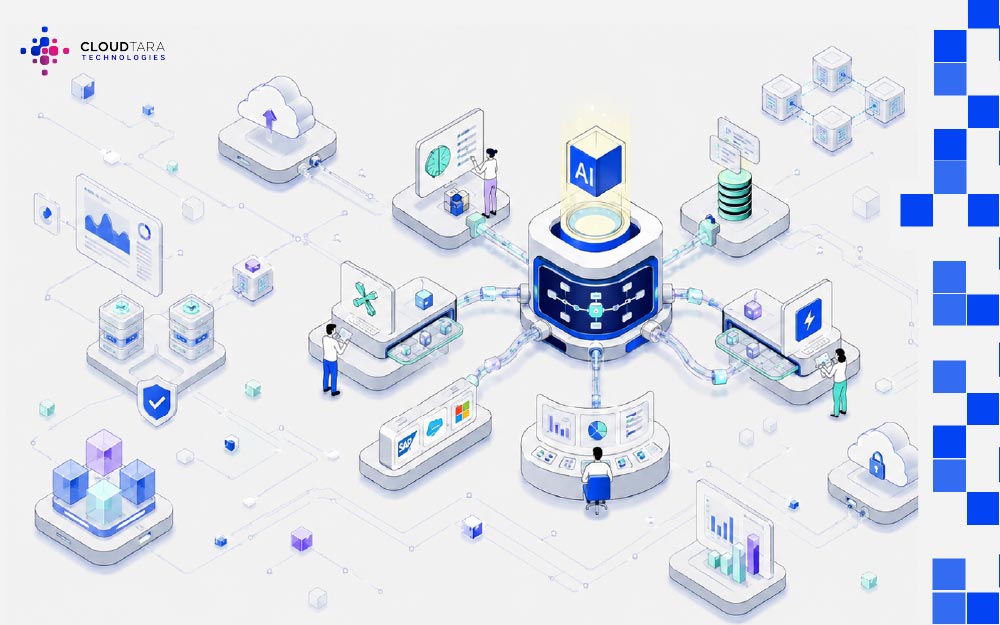
The CloudTara's enterprise approach is focused on connecting AI, workflow automation, and existing enterprise systems. This approach helps organizations scale their workflows while keeping everything under control.
Enterprises do not need one platform for every use of automation. They rather need a clear foundation, which defines how all the existing tools and workflows work together.
Start standardizing the repeated capabilities used across different workflows
The following may be involved:
- Identity and Access Management
- Retrieval of Data
- Integrations across Enterprises
- Processing of Documents
- Notifications
- Human approvals
- Audit logging
- Monitoring
If each workflow integrates these capabilities separately then it solves the same technical challenge.
Moreover, components that can be used multiple times enable the company to develop without incurring technical debt further.
Keep workflow logic apart from AI solutions
Processes in the company should never rely on one and the same platform, model or vendor.
AI systems will develop in the future.
A workflow architecture where business logic is separated from AI components will allow a business to change means anytime they need.
This is essential for businesses that do not wish to tie their automation efforts to one provider.
Create a single governing body
The governing body should not require long delays in starting the new automation process.
Instead, organizations must clearly define the rules regarding:
- Which data can be accessed by an AI system
- Which actions can be executed by an AI system
- What actions require human approval
- How exceptions are treated
- How activities and results are monitored
These guidelines make uniformity possible as workflows multiply.
A solid base enables companies to be more flexible and adapt their automation approach as needed. Solutions provided by CloudTara utilize AI technology and data services to build capabilities with existing workflows, systems, and business needs in mind.
How to Implement AI Workflow Automation on a Large Scale without Getting Lost in Multiple Tools
A practical approach starts with six points:
1. Focus on workflows rather than tools
Do not ask the question "What automation tool should we purchase?"
Instead, ask the following question "What existing workflow creates issues in the company?"
Consider manual work, waiting times, work that is done repetitively, handoffs between different people and systems, mistakes made in the decision-making process, etc.
When organizations Scale AI Workflow Automation, starting with the workflow rather than the tool helps ensure that expansion is driven by actual business needs instead of simply adding more technology.
Tools are chosen later based on the understanding of the issue.
2. Make an inventory of existing automation tools
Before purchasing another tool, it is important to understand what the company already has.
Make a list of existing automation tools, programs that use AI, major integrations with existing tools, automated workflows, data sources, responsibilities, security measures, and prices
This will help in discovering overlapping tools used in different parts of the company.
3. Identify items that can be reused
Not every workflow has to be the same.
However, certain capabilities should not have to be recreated each time.
For example, if several workflows need users' customer data from CRM, companies must look for a way to reuse access to that information.
The similar principle works for approvals, notifications, identity, monitoring, etc.
4. Define boundaries of autonomy and approvals
Not all processes should function totally independently.
Determine what activities AI can perform automatically and what should be confirmed or done with people's involvement.
This is extremely important for any financial and legal processes as well as for customer, security, and compliance-related processes.
The aim of automation is controlled automation rather than automation at all costs.
5. Measure business results
The number of automated processes is not a good measure of success.
Track such measures as:
- Process time
- Cost per transaction
- Error count
- Employee time saved
- Customer response time
- Escalation rate
- Operational incidents
- Impact on business
This will allow managers to differentiate automation that brings value and automation that adds just another tool.
6. Get rid of things that do not bring value anymore
Scaling means not only introducing new technology but also eliminating unnecessary technology.
If two platforms do exactly the same work, ask yourself if you absolutely need both of them.
An effective automation environment should be able to increase its performance without becoming unnecessarily complicated.
When is the time for companies to consolidate their automation tools?
Not all companies have to choose one platform for their implementation.
Consolidation is justified only if there are too many tools wasting resources and creating unnecessary overlapping operations.
The indications of the need for consolidation are:
- The use of many different platforms connecting to the same enterprise system
- The implementation of the same process in different tools
- The increase in maintenance of integrations
- The increase in costs of the software
- The different rules of governance of different teams
- Confusion regarding the ownership of the processes
- Long timelines for change because of the necessity to change several platforms
The right question to ask is not:
"Can everything be accomplished by one tool?"
But:
"What functionalities should be standardized and where should specialization be used?"
This is how companies will simplify matters without excessive limitation.
As far as the approach to consolidation is concerned, the concentration has to be on simplifying the workflow environment rather than just reducing the ownership.
As enterprises Scale AI Workflow Automation across departments, this becomes increasingly important because every additional workflow can add integration, maintenance, and governance requirements.
Ownership in Business
The person in charge of results is responsible for the performance of the procedure.
Ownership in Technology
It is necessary for a particular individual to control integration, hardware, and any technical elements.
Ownership in AI
Appropriate supervision of models, agents, evaluation, and efficiency of the AI is required.
Ownership in Risks
Clear accountability for safety, access, compliance, and escalation regulation is compulsory.
Ownership in Effectiveness
An individual must always check if the process is efficient and delivering the exact value of business.
Without these obligations, automation becomes just a group of initiatives instead of involving enterprise level of development.
Where does CloudTara Fit
Scaling up AI workflow automation does not necessarily mean changing the technology that is already used by the enterprise.
The idea is to find the best mix of technologies and integrations to solve business problems.
CloudTara has a product-oriented approach to enterprise technology, which means combining the AI-enabled intelligence with workflow automation and integration technology.
The company's AI and data positions cover: workflow automation, AI coding solutions, AI strategy, agentic AI solutions, and other fields of this technology.
The goal is straightforward – to enhance the efficiency of automation without complicating technology.
In Conclusion
The use of AI for workflow automation will continue to increase in business organizations.
However, companies that will make the best use of AI tools will not be those that have the most options available but those that will be able to introduce new automation without having to reinvent the wheel every time by making new integrations, governance processes, and creating dependencies on technology.
This calls for working with the workflow, creating reusable capabilities, and governance.
The target should be more processes which are automated rather than having more AI tools in place.
.jpg)
.jpg)