According to Gartner's predictions, the share of enterprise software programs involving agentic artificial intelligence will grow from 1 percent in 2024 to 33 percent by 2028. Also, by that time, at least 15 percent of office decisions will be made with agentic AI help.
Agentic workflows refer to the artificial intelligence-based procedure in which autonomous agents make decisions and perform tasks with minimal human involvement instead of performing a set of static actions.
Within the article, agentic workflows will be described in detail, differentiating them from traditional automation and providing guidance on their usage. Additionally, there will be a list of their key features and advantages, drawbacks, and practical steps towards implementation.
What Are Agentic Workflows? A Clear Definition
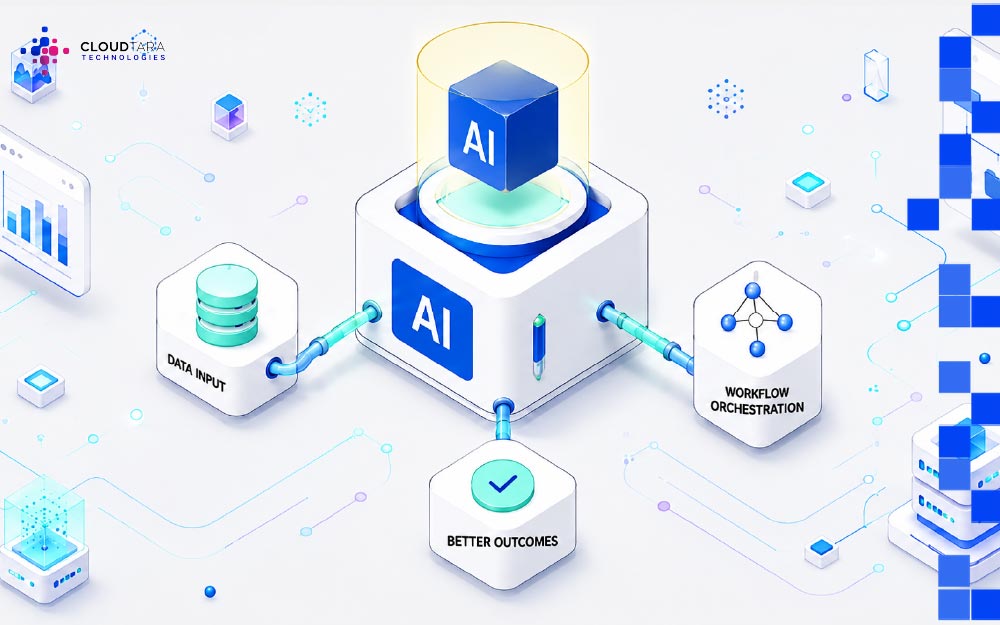
Agentic workflows are business processes that are objective-oriented and are conducted by an AI agent or agents. The agents interpret the goal, prepare a scheme, use the connected tools, evaluate the outcomes, and make a decision about the next step.
The major distinction between agentic workflows and traditional automation is the way the system determines what to do next.
- In traditional automation, the system is deterministic. There is usually the same input and path to follow.
- In contrast, agentic workflows are non-deterministic. The system can make different decisions due to the environment, available information, and outcomes.
To clarify, think of the example of cooking. RPA sticks to a certain recipe exactly, while the agentic workflow acts as a chef who knows what he wants to achieve and varies the recipe according to the ingredients available.
This trait enables the business to automate the tasks that deal with unstructured data, variable circumstances, and decision-making that cannot be transformed into simple “if-then” statements.
Yet, agentic doesn’t imply that the system works inappropriately. The objective, permissions, tools, regulations, and circumstances have to be defined by humans.
Agentic Workflows vs. Traditional Automation: Key Differences
Traditional workflow automation follows predefined rules, conditions, and paths. It works well when processes are stable, repetitive, and structured, such as transferring files between platforms, processing standard invoices, or migrating structured data. However, when an unexpected situation occurs, the workflow usually requires human intervention or manual reconfiguration.
Agentic AI workflows are designed for more complex and variable processes. Instead of simply following a fixed sequence, they evaluate available information, understand the context, choose the appropriate next action, and adjust their approach when conditions or outcomes change.
The role of human oversight also differs. In traditional automation, teams must design and maintain most of the workflow logic. In agentic workflows, humans establish goals, boundaries, and approval requirements, while the AI handles routine decisions. People remain involved in reviewing exceptions, sensitive decisions, and high-risk actions.
This makes traditional automation suitable for predictable tasks, while agentic workflows are better suited to knowledge-intensive work that requires analysis, judgement, tool selection, or changes in direction.
Organizations do not need to replace their existing automation systems entirely. A more practical approach is to combine deterministic automation for predictable actions with agentic AI for decisions, exceptions, and changing conditions.
How Do Agentic Workflows Work? A Step-by-Step Breakdown?
In most cases, AI agent workflows follow a continuous loop of comprehension, preparation, execution, and evaluation. The structure may differ in its manifestations, whereas the five phases listed below represent the principle of agent work.
Step 1 — Receiving information and setting a goal
At this stage, the workflow is triggered by taking input in the form of a request from a user, an API action, a database change, or a scheduled event. The agent receives a broad goal, which may be either for solving a support issue or preparing a compliance report instead of a complete task instruction.
In addition, there can be human interference in the form of providing some restrictions, deadlines, criteria for success, and actions that need to be agreed upon.
Step 2 — Preparation and subdivision of the goal
At the next step, the agent dissects the goal into several minor goals, puts them in a certain order, and chooses all necessary means or additional agents for each minor task. Planning is done using an LLM that interprets language and context, also understanding the correlation of the data.
Step 3 — Utilization of Instruments and External System Solutions
The agent utilizes authorized APIs, databases, research tools, CRMs, document storage, or enterprise software. It can access real-time data, produce files, or perform allowed actions, instead of solely depending on the training data.
Here is where agent-based workflow automation brings real business results. The agent not only provides answers but also starts doing its work in non-automated systems.
Step 4 — Decision-Making and Flexible Routing
After performing the task, the agent checks what has happened and determines whether to proceed, change its approach, ask for more details, or elevate the issue. People put it in this way: Thought-Action-Observation loop: consider the situation, perform an action, see the outcome, and choose the next step.
If there is a failure in an API, a necessary document is absent, or the results do not meet the demanded threshold, then, instead of stopping the workflow, it would take a different route.
Step 5 — In-person involvement and output delivery
The enterprise agent workflow should ensure that sensitive and important decisions going out should be decided by an authorized individual. This may involve authorization of a payment, verification of a customer reply, or approval of an exception to a policy.
Once the necessary checks have been conducted, the agent provides the output; this could take various forms, including sending an email, updating a CRM entry, writing a report, scheduling a follow-up, or closing a service request. The process and history of approval must be documented for control and auditing purposes.
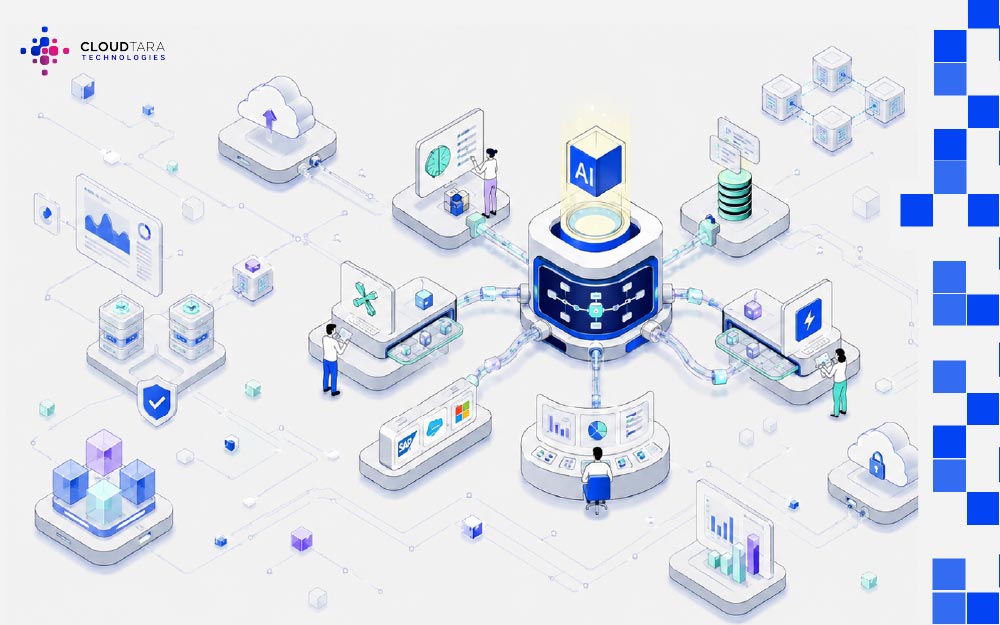
Core Components of an Enterprise Agentic Workflow
- LLM reasoning engine
The language model performs the role of interpreting goals and unstructured information and assisting in making the right action choices. It works like a reasoning layer, but it must do so within allowed directions and privileges.
- Memory
Short-term memory keeps the context while performing the task. Long-term memory contains the preferences allowed by the user, previous communications, and effective results obtained during the full process of work.
The memory must be limited. Keeping all the communications without rules of retention is dangerous in terms of privacy and data quality.
- Tool integrations
The tools help agents to search the databases, call APIs, obtain documents, and perform actions in the enterprise systems. Their effectiveness depends on how safe and reliable the enterprise AI integration is.
- Orchestration layer
The orchestration layer brings everything together: agents, tools, workflow statuses, retries, dependencies, etc. It can deal with a single agent accomplishing a few steps or several specialized agents working together for one goal.
- Guardrails and governance
Guardrails suggest what access the agent will have and which actions it will perform, and when human consent is needed.
Top Use Cases of Agentic AI Workflows in Enterprises
- Financial services and insurance claim
The process of interest in question is what is known as an agentic process in workflows. It means that the workflow can gather claim documents, verify the policy, find evidence needed, and send suspicious or complex claims to specialists.
Aviva has shown the successful results of AI-based claims renovation. The company has managed to improve client satisfaction by 65%, and its overall net promoter score increased more than seven-fold. This is not confirmation that only agentic workflows were used in this case but serves as a perfect example of what can be done using AI-supported innovation in workflow methodology.
- HR recruitment process
The workflow in this sphere is also based on the idea of an agentic process, which allows gathering joining papers, opening accounts, and informing the stakeholders regarding the new employee.
- IT assistance
An agentic process for IT support works automatically, making it possible to read the ticket, get information from the system, check available databases, perform approved diagnostics, and produce answers.
- Sales research and outreach
Agents can collect account details, recognize significant business activities, refresh CRM fields, and create tailored outreach. Human checks are important before any communication, especially for important clients and regulated sectors.
- Supply-chain activities
Agents may track supplier updates, inventory levels, delivery information, and external disturbances. When a possible delay occurs, the workflow assesses alternatives, measures effects, and presents solutions to an operations supervisor.
Key Benefits of Agentic Workflows for Enterprise Teams
- Reduction in manual labor
Agents can conduct research, collect data, perform system updates, and track information that would otherwise require workers to shift from app to app many times.
- Quicker decision cycle
By creating the right context at the moment of decision-making, agentic workflows help avoid delays induced by manual data searches and interdepartmental transfers.
- Ability to scale without proportional employee growth
With an efficient workflow, your business can handle a larger number of requests without hiring more staff.
- Better approach to complex tasks
Unlike static scripts, agents can use disorganized documents and different situations. The results they achieve depend on the quality of information, evaluation criteria, and proper human supervision.
- Continuous improvement of processes.
The records contained in the workflow and its approved memory can provide information about typical exceptions, system bottlenecks, and solution patterns.
Challenges and Risks Enterprises Should Know
Agentic AI technology in companies creates dangers that traditional automation could not create.
- Data protection and confidentiality
Agents could access sensitive data, making their ability to access information larger than necessary a matter of concern.
It is advisable to implement least privilege, roles, encryption of information, and a data retention policy. This means an agent must have access only to that data and tools.
- Non-deterministic outcomes
The agents’ ability to choose how to act based on the situation means agents may process similar requests, producing different outputs.
- Shortcomings of responsible governance and accountability
Organizations should be aware of who operated an AI agent, the information the agent refers to, the methods it used, and who gave approval. If there is no traceability, it is hard to investigate mistakes and prove compliance.
A practical model of AI governance for companies should include such components as ownership, access management, experimentation, visibility, forensic trails, and business continuity.
- Over-automating
Not every decision can be entrusted to an AI agent. Automation of processes without understanding deviation patterns can lead to the genesis of mistakes instead of eliminating inefficiency.
One should involve humans in situations when decisions can cause any issue related to human rights, safety, employment, finances, or customers’ trust.
- Lack of insight into business value
Agentic technology can bring complications and costs of applying it to the wrong task. Gartner mentions that more than 40 per cent of agentic AI projects will be terminated by 2027 because of rising costs, unclear value, or insufficient risk control measures.
Therefore, companies should start with those workflows where there are bottlenecks plus a clear business outcome.
How to Get Started with Agentic Workflows in Your Enterprise?
- The first step is to choose a suitable workflow process. The best candidates are clearly defined processes that have been previously run to show feasibility, and feature decision-making and manual effort while also automating minimal steps. Sample metrics to take into consideration include the time of implementation of the workflow (how long a case takes), the costs of operating it, the number of errors that have occurred during work, the level of complexity of the workflow, etc.
- The second step is to find the suitable orchestration platform for your organization. There are various systems on the market to choose from (including LangChain for creating unique workflows through the methods of interacting directly with users, Agentforce for processing Salesforce data, etc.) The platforms (LangChain and Agentforce) are considered leading solutions due to their variety of capabilities, ease of use, etc.
- Initially, the agent should be permitted to recommend actions or generate outputs for evaluation. Only once the normal cases, edge cases, malicious inputs, and failures of the system have been tested should autonomy be extended. Monitor business results in addition to technological metrics such as success of the task, number of tool-call errors, rate of overruling, and outputs that cannot be generated. Experienced agentic AI implementers can assist organizations in building up a promising case into an organized production cycle, if necessary.
Final Thoughts
The concept of agentic workflows denotes a paradigm change from rule-based automation to AI technologies that achieve objectives. This capability includes planning, using instruments, analyzing the outcomes, and modifying plans subject to the results, leaving major decisions to people.
According to Deloitte's estimates, in 2025, around 25% of firms implementing generative AI will utilize AI agents, and this number will grow to 50% by 2027.
The right strategy is not to stick agents into each process but to redesign the appropriate workflow based on trustworthy data, controlled but effective autonomy, and having measurable effect. CloudTara can help enterprises identify that workflow and build a practical path from pilot to production.
.jpg)
.jpg)