Physical labor does rarely seem like a grave issue at a company. It appears in the form of hundreds of small tasks. For example, taking data between two systems, checking documents, handling standard calls, updating documents, making reports, and collecting approvals.
In and out of itself, each of these tasks is manageable. However, when it comes to operating on a corporate scale, all of them take lots of time from employees and create troubles with delays, mistakes, and inconsistencies.
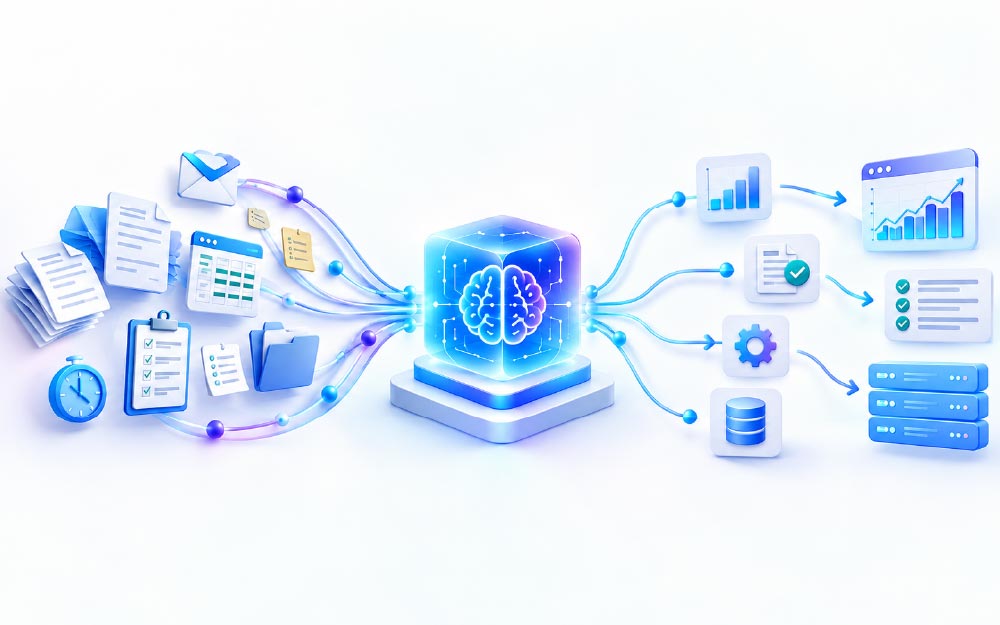
This is where AI Automation Services function. A firm can apply AI not only to automate separate processes but to receive and understand information, make routine decisions, initiate actions, and pass burdens between various systems.
The real potential for businesses lies in the integration of AI into existing workflows and systems instead of gaining automation solely for the sake of it. With that in mind, CloudTara takes the same approach and combines AI, workflow automation, and current enterprise systems to solve real business challenges.
What Are AI Automation Services?
AI Automation Services refer to the use of artificial intelligence technology to automate business processes that would normally rely on human efforts.
While traditional automation can do its job effectively provided that a business process is standardized, in which case some actions can be triggered by set rules, data gets transferred from one system to another, and some requests follow a predetermined sequence of actions, with AI being added to the process it becomes able to work with unstructured information, making sense of queries, getting relevant data from different documents and other types of information, classifying requests and summarizing text, detecting patterns, providing recommendations, and making decisions based on relevant information about the business process.
For instance, an accounts payable process can be illustrated as follows:
While a traditional workflow would transfer invoices from one system to another, an AI-enabled workflow can do much more.
- Reading an invoice
- Matching it to purchase orders
- Determining whether there are any inconsistencies or missing information
- Making sense of the invoice
- Sending it to be approved
- Updating the relevant business system
- Pointing out any possible discrepancies for it to be checked by an employee
The goal is not to remove human beings from this process per se, but rather to eliminate repetitive work that doesn't need to be done by a person.
Such distinction is crucial in the process of evaluating AI automation by an enterprise. The main goal of AI is not to gain another isolated automation tool, but to improve the entire process.
In what areas does manual labor slow down the operation process in enterprises?
Before trying to invest in automation, the business has to determine where manual labor exacerbates operational bottlenecks.
Data entry and system updates
Employees often have to enter the same data in several places. When updating customer information, one might need to update their data in the CRM, also in the billing system, and even billing platform, and support system.
This leads to unnecessary workload and risk of inconsistent data.
Processing Documents
Invoices, contracts, order forms, various reports, claims, and customer documents come with lots of information that needs to be analyzed by employees manually.
Thanks to AI, it can analyze these documents and provide relevant data to the next phase of the process.
Customer and Employee Inquiries
Some requests are predictable.
For example:
- Password or access request
- Order status inquiries
- Hiring of new employees
- Service requests
- Updates to an account
- Internal questions of the IT department
With automation, company employees can avoid doing everything manually.
Data Analysis and Reconciliation
Moreover, teams waste considerable time gathering data from different systems, filling spread sheets, finding differences, and creating regular reports.
This is yet another area where Automation can save a lot of time and make the task less tedious.
Where AI Automation Creates the Most Value
1. The Right Method of Automation
In most cases, the best automation opportunities lie within connecting a number of simple processes into one bigger process.
For instance, when a new customer fills out the form, the automated process will extract the details, check if mandatory fields are filled up and maintain or create a record in the company's CRM. Whenever the relevant team needs to be informed and the next action triggered, automation takes care of that, too.
Thus, employees will not have to take these actions manually anymore.
2. Transforming Unstructured Information into Useful Data
Many business data does not come to us already divided into database categories.
It comes in emails, PDFs, contracts, messages, forms, and documents.
AI can help in obtaining usable information from these sources, so that it can be used further by other workflows.
To illustrate, a procurement workflow finds out supplier-related data and pricing information from documents and then passes them for verification.
3. Automating Routine Decisions
Not all decisions in business need managers' attention.
Be it a matter of well-established practices and thresholds, AI-supported automation can manage standard decisions on low-risk matters automatically with exceptions routed to the right person.
This way, management of everyday work is handled automatically, while employees concentrate their efforts on really vital situations.
4. Integrating Various Company Systems
Manual labor appears because systems fail to communicate well.
A customer-service worker may have to switch between a CRM, an order management system, a billing system, and a knowledge base just to comply with one request.
With AI automation, one can conduct the actions across these systems, which minimizes the number of manual processes.
This is where CloudTara's approach to AI and data services makes sense: its solutions concentrate on connecting AI and automation with currently existing systems and workflows instead of treating AI as an independent layer.
An often-encountered mistake is to try to automate the whole process without taking exceptions into consideration.
A more appropriate model is to automate the predictable majority of tasks and direct unusual tasks to humans.
For instance:
- Standard invoice → process automatically
- Missing PO → refer for review
- High amount → seek approval
- Suspicious information → escalate to the proper team
That allows businesses to Automate Manual Processes and maintain human control where it is necessary.
Finance
Some potential applications can be:
- Processing invoices
- Verifying expenses
- Directing payment approvals
- Carrying out reconciliation
- Preparing financial statements
- Identifying exceptions
However, the entire benefit of using automation lies not just in reducing the number of steps performed manually. Finance staff may now devote time to analyzing the situation and searching for exceptions rather than doing routine processing.
Customer Operations
Customer support teams can use automation in:
- Classifying requests
- Finding relevant client information
- Providing recommendations for responses
- Assigning requests
- Sending reminders
- Updating CRM systems
Thus, AI can help workers to streamline dealing with many requests and does not require manual handling of each case.
Human Resources
HR processes involve a lot of routine work, such as onboarding, working with documents of employees, processing requests to get access, answering policy questions, and dealing with requests for internal services.
Automation can manage these tasks throughout HR information systems, IT systems, and communication channels used by employees.
IT Operations
Automating repetitive service requests, classification of incidents, management of access requests, monitoring of systems, and performance of routine operations provides a lot of benefits for IT departments.
More advanced AI technologies can enable employees to make interpretations of incidents and define further actions.
Sales and Marketing Operations Strategy
Often sales teams perform tasks that involve doing research on accounts, logging data into CRM systems, providing information, and contacting leads.
However, thanks to AI automation, organizations can alleviate the burden of these administrative jobs.
The main purpose of automation is providing sales teams with the time they need to sell and connect with customers instead of achieving the highest efficiency possible with the help of a bigger number of tools.
Differences Between AI and Traditional Workflow Automation
Despite the fact, AI and traditional automation are often seen as incompatible concepts, in reality, they can and should work successfully together.
Traditional automation means that the process is following certain regulations. However, when you need to rely on understanding the process you deal with, AI comes into play.
For instance, when dealing with the payment process, traditional automation means passing the invoice to the payment processor when it has been approved.
AI will have to read the invoice, find out which supplier and the amount of money is involved in the transaction, and establish whether there is an exception and where the payment should be directed.
Follow predictable actions or rules in AI operations. AI can engage in interpretation, categorization, recommendations, and variations or unique aspects of the operation.
This approach can be more optimal than trying to make every function "AI-enabled."
Prior Factors to Consider for AI Automation Solutions
Not every opportunity for automation calls for the use of AI. Businesses should also evaluate security, integration, governance, scalability, and business value before selecting an AI automation approach.
Below is a checklist companies should use when choosing an AI Automation Solutions company.
Compatibility With Current Systems
An AI solution must work with what staff already have.
Ask yourself:
- Can it integrate with existing systems and APIs?
- Can it integrate with CRM, ERP, HR, or IT system?
- What is the data flow?
- Will such solution need any replacement of existing technology?
If such a solution creates another system in addition to the existing one, it will drastically reduce the manual workload in one particular area but raise the operation costs in another area.
Governance and Access Management
AI automation can deal with sensitive business information, so enterprises should have some governance around:
- Data access
- User roles
- Approval process
- Audit trail
- Exception handling
- Human supervision
The level of significance of actions determines the degree of importance of required automated policies.
Scalability
A small pilot project may function seamlessly with one group while failing to maintain its effectiveness in large-scale activities involving multiple teams.
The system of enterprise AI automation should therefore be created in such a way as to deliver positive results thanks to its standard procedures, flexible enforcement of the rules, constant monitoring, and easy updates.
Monitoring and Customer Support
Automation doesn't mean one can eliminate responsibility for operations.
Companies have to understand whether processes are being executed properly or not, where something is going wrong, or where human involvement is needed.
The system of monitoring is thus considered as an integral part of the functioning system, not just something that needs to be implemented after the completion of the project.
Business Metrics
Finally, it is time to see what outcomes have been achieved.
The set of indicators that can be taken into account includes:
- Time for processing
- Cost per transaction
- Error rates
- Saved man-hours
- Time for responding
- Number of handoffs
- Rate of exceptions
- Level of customer satisfaction
The quantity of workflows cannot be considered a successful proof of advantageous automation.
A better way to start is through looking at the process.
Begin with the Bottleneck
Find out where your employees are using most of their time.
Look for:
- Repetitive data entry
- Large volume requests
- Frequent hand-offs
- Manual reconciliation
- Delays between the systems
- Recurring document processing
- Repetitive report preparation
These usually prove much better bases for the start rather than the selection of a new AI tool.
Outline the Current Workflow
Understand what happens before the automation is implemented.
Who starts the process? What systems are involved? What is the origin of the information? Who approves the next stage? What is the outcome when there goes something wrong?
Without a proper understanding of this, automation risks becoming nothing more than a quicker version of today's inefficient process.
Establish Where AI Is Required
Not every step requires AI.
Some steps just need an API-traditional workflow.
Use AI only where classification, interpretation, summarization, and forecasting bring benefits.
This approach makes the design easier and thus the costs controllable.
Keep the People Where They Belong
High-risk decisions should not be fully autonomous.
For matters concerning the approval of funds and compliance measures, commitments made by clients, or data management, companies might wish to consider manual verification prior to undertaking any activity.
The goal should be about controlling the processes of automation rather than maximizing its implementation.
How to Create a Viable Strategy for Enterprise Automation
Most benefits should come from the perception of automation not as a set of projects but as a business model.
The first step in setting the course of automation should be developing reusable solutions related to important functions, for instance:
- Identity and access
- Data retrieval
- Notification
- Document handling
- Approval
- Systems integration
- Monitoring
- Audit log
This strategy saves each department from solving the same technical tasks separately.
CloudTara also focuses on the connection of AI and automation with other technologies with the purpose of simplifying processes rather than introducing additional technologies unnecessarily.
How to Start Implementing AI Automation Services
It is not necessary to automate all processes at once.
Step 1:
The first stage involves distinguishing a process of significant value that will be able to be measured by effort, volume, or delay.
Step 2: Create a Map of the Current Workflow
Record the systems involved, the individuals participating, what approvals are needed, where the data comes from, what exceptions exist, and how handoffs occur.
Step 3: Choose an Appropriate Approach to Automation
Identify what type of automation (traditional, AI, integration, or human) will be utilized in each step of the workflow.
Step 4: Perform a Thorough Test of the Pilot
Verify how effective the workflow is in achieving a specific business goal with a predetermined metric of effectiveness.
Step 5: Evaluate the Results
Analyze how much faster the processing becomes, how many mistakes occur, how much effort has been put in by staff, what it costs, and what happens afterwards.
Step 6: Use the Successful Approach on a Larger Scale
After getting a positive result from the tested workflow, apply it more widely through the adoption of reusable integrations and governance, instead of developing another independent automation solution.
As a result, the chances that too much money or effort is put in automation before it is clear what exactly is valuable become very low.
Where CloudTara Comes Into Play
CloudTara handles AI strategy, workflow automation, AI product development, enterprise modernization, integrations, and further assistance with AI solutions.
For companies, it is less about incorporating another AI solution and more about finding ways in which AI can enhance an existing business process, connecting the right systems, and creating an automation model capable of growing alongside the business.
Conclusion
Just because a company has implemented AI does not mean that manual labor will cease to exist.
The true advantage lies in redesigning workflow within a company.
AI Automating Services help companies minimize manual data processing, link different systems, process unstructured data, make certain routine decisions, and pass exceptions to the right persons.
However, technology is just part of the equation.
The success of automation depends on choosing the right processes, linking the existing systems, setting up governance, measuring outcomes, and determining the areas that still require some human involvement.
Therefore, when considering AI Automation, businesses should ask themselves the right question: "What can be automated?"
It asks the question:
"Which manual process is causing hindrances to the business, and how can it be automated effectively?"
Through the transition from implementing advanced technology to optimizing work processes lies the trick of turning automation from merely another IT project to something that can be measured and evaluated from the standpoint of its real benefit to the business.

.jpg)
.jpg)
.jpg)