In the current scenario for enterprises, utilizing AI is not a simple matter of testing a new technology. The fundamental question is where to apply AI, how to integrate AI with existing systems, and what factors influence the transition from idea conception to a working solution.
This is the situation where AI consulting services become helpful. When enterprises use these services, they can correctly determine the use cases that make sense in their case, create an efficient AI strategy, evaluate their technical readiness for AI adoption, and plan the implementation process accurately.
At CloudTara, we have a specific approach as a business. We connect AI strategy, automation of processes, integrations, and modernization with the existing technological environment of our clients.
However, selecting an AI consulting market player should not rely on technical capabilities only. Enterprises need to find a partner that understands the importance of business aspects, legacy systems, data management, security issues, governance, implementation, and AI scaling.
Importance of Choosing Quality AI Consulting Services
Many companies start utilizing AI technologies through the use of separate experiments. A task force may try out an AI assistant, automate a process, create a predictive model, or analyze the applicability of generative AI for a specific department.
The pilot phase of an AI project may go well from a technical perspective. But there are many questions that might arise once implementation is complete.
- Can it be integrated into existing solutions?
- Will users be able to work with it effectively?
- Is data security guaranteed?
- Will IT be able to maintain the solution?
- Will it be ready to scale beyond the pilot department?
The answer to those questions determines whether an AI project will result in a valuable business capability or remain an experiment.
Good AI Consulting Services should consider the whole journey from the business perspective - not just the AI technology itself.
What Should a Good AI Consulting Include?
Not every consulting company provides the same AI service. So before choosing a partner, organizations should understand what they will get.
1. Business and Use-case Discovery
AI should solve an important business problem.
A good consulting partner should first understand the processes that are currently in place, as well as the barriers that companies face.
For instance, a large corporation may discover opening in:
- Automation of consumer services
- Processing of data and documents
- Management of internal data
- Analytics with prediction
- Automation of procedures
- Development of software
- Operations of supply chain
- Enterprise search and analytics
The key question should not be "Where is it possible to apply AI?" but "Where can AI improve a currently functioning business process?"
2. A Usefulness AI Strategy
The pretty good AI Strategy should unite technical decisions to business goals.
It should state what use cases should be chosen, what will be necessary, what systems and data will be involved, and how measurement will happen.
If this strategic level is missed, big companies can easily have separated projects without any tools and scheme which is difficult to scale.
An appropriate consulting partner should assist in creating a roadmap taking into consideration both short-term opportunities and long-term requirements of Enterprise AI.
3. Tech and Data Preparedness
AI systems are strongly dependent on environment in which they operate.
Before AI systems are implemented, organizations should understand something:
- Where data needed is
- How reliable and accessible will be this data
- What systems should be united
- What APIs or connectors exist
- How the current infrastructure can support the solution
- Which security controls are necessary.
- How it will be monitored post-deployment.
It helps to find out limitations in advance before it becomes an expensive implementation problem.
4. AI Implementation Planning
A strategy is only good if you can implement it.
The provider must explain clearly how they based on AI.
Organizations need to ask their consulting partners how they manage going from proof of concept to production system.
The solution is not effective unless it is capable of being embedded in the company's systems.
5. Integration with Current Systems
Most enterprises operate in complex technology environments.
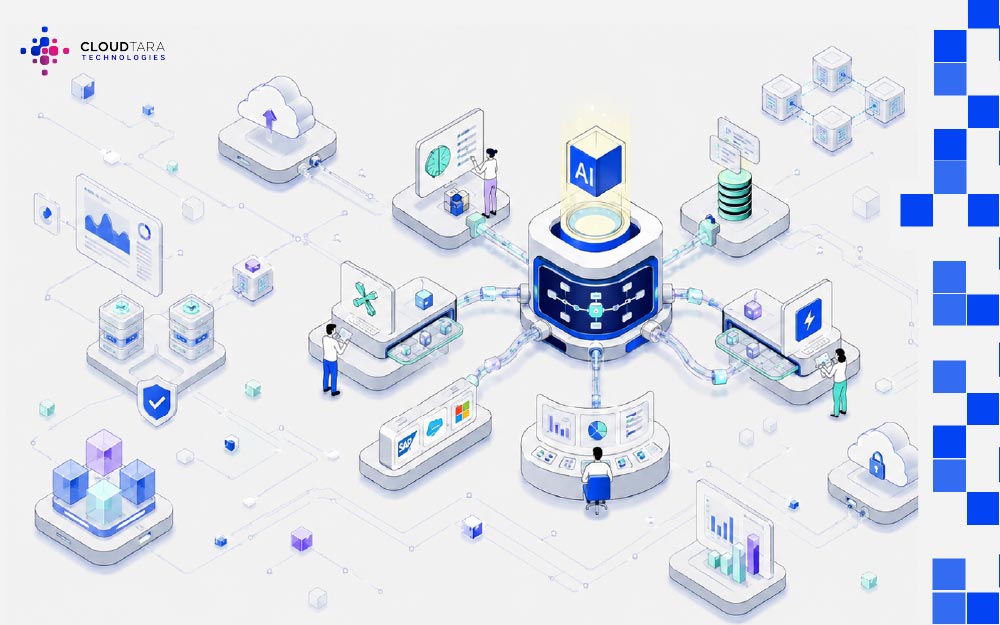
ERP systems, CRMs, data warehouses and internal applications, cloud infrastructure, APIs, and legacy systems can be present in a single workflow.
It means AI often cannot operate independently.
CloudTara helps successfully integrate AI capabilities with existing enterprise workflows.
For companies already juggling several platforms, this is especially relevant, as they are not interested in adding yet another independent technology layer.
How to Compare AI Consulting Providers
After a number of candidates have been on the shortlist, companies should find a method for comparing them.
Instead of stressing solely on technical qualifications and modern AI terms, check for the way each consulting firm approaches real business realities.
1. Make Sure They Have Relevant Enterprise Experience
In a nutshell, you need to ask whether a consulting firm has worked with enterprises of that size and complexity.
Relevant experience could cover:
- Large integrations
- Data & AI platforms
- Workflow automation
- Legacy systems modernization
- Cloud environments
- Enterprise security
- AI-based production systems
- AI operations support
The objective is to find out if the consulting firm is capable of handling the entire technology ecosystem of the AI project.
2. Check Their Approach to AI Strategy
Ask what happens even before any development work is done.
A competent consultant should explain how they identify use cases, prioritize tasks, evaluate readiness and develop a roadmap for the initiative.
When conversations begin with a specific AI technology, platform, or tool without examining the business issue in depth, it may indicate that the focus of the talk is on the technology rather than the outcome.
The next thing is to ask how production is being done.
Some key questions are:
- How do we test AI solutions before being put into production?
- How are integrations being handled?
- How is access to data regulated?
- How do we monitor performance?
- Who handles updates?
- How do we handle failures?
- What if output given is incorrect?
- How can we scale a solution as usage increases?
This series of questions can tell the provider's understanding of the operational side of Enterprise AI, not only its experimental aspects.
What does Enterprise AI Consulting involve?
It is a multi-step process rather than just making the choice of AI technology.
Steps include:
1. Identify
Here the aim is to understand the company's aims and to identify the processes where AI can bring a significant difference.
2. Assess
Evaluate data, infrastructure, integrations, security, workflow as well as organizational readiness.
3. Prioritize
Decide which cases should move forward based on some criteria (business value, complexity, risk, feasibility).
4. Build
Create and incorporate the artificial intelligence skillset into the present technological framework.
5. Deploy
Implement the solution with all forms of testing, security, surveillance, and overseeing throughout the process.
6. Improve
Monitor productivity and outcomes and make adjustments based on the requirements.
This way can avoid situation when artificial intelligence solutions are separated and hard to manage.
Common Pitfalls Enterprises Face When Choosing AI Consulting Services
Organizations with well-trained experts can still make unwise consulting decisions, due to focusing only on technology evaluation.
1. Choosing Based on AI Capabilities Only
Knowledge of artificial intelligence is important, but corporate projects bring the need for integration, architecture, security, data development, workflow knowledge, and operational maintenance.
The consultant may have a perfect understanding of AI, but it can be problematic to use this understanding in wide corporate settings.
2. Choosing Technology Before Identifying the Problem
Selection of the model or platform before defining the business issue leads to unnecessary limitations.
The technology must fit the defined use case and not be the determination.
3. Disregarding the Current Workflows
AI solutions tend to fall short of providing the expected value. Why? The employees are obliged to abandon their habitual systems and processes to utilize the solutions.
The more seamlessly AI fits into the current workflow, the more convenient its adoption will be.
4. Considering the Pilot as the End Goal
Just because the pilot went well doesn't mean it is possible to put the AI solution into mass production quite yet.
Production demands more attention to reliability, security, integration, monitoring, governance, and ownership.
5. Neglecting the Plans for Follow-Up Support
AI solutions can't usually be implemented only once.
Models, data, business needs, integration procedures, and user requirements may vary. Companies should know who is going to take care of their AI systems after their launch.
Things to Discuss Before Picking an AI Consulting Company
- What steps do you take to choose and determine important AI cases?
- How do you create an AI strategy?
- How do you evaluate your existing systems as well as your data?
- How do you transition your AI projects once they are past the pilot stage?
- How will the proposed solution fit into your company's existing working structure?
- What strategies do you use to implement security, governance and access management?
- How does the process continue following implementation?
- What criteria do you use to evaluate the impact of an AI implementation?
- Can your method accommodate different AI projects in accordance with our future demands?
- What services will your team provide in the framework of the implementation?
Answers are often more relevant than a mere list of technologies and certificates.
AI Consulting Services Should Add Value To Your Company
Enterprise AI cannot be used separately.
It has to interoperate with the applications and processes, data, people and infrastructure you are using already for running your business. Hence, simplicity and easy integration are no less important than technical capabilities.
CloudTara employs a broader vision approach to enterprise technologies, combining AI, workflow automation, integration as well as modernization.
Decision makers must assess service providers based not only on their deliverable products but on how efficiently they can assimilate them to the existing environment of the company.
How CloudTara Fits
AI Consulting Services is all about choosing a company that can combine the process of strategizing and implementing.
With CloudTara, companies have the opportunity to go from coming up with the AI strategy and use case identification to constructing solutions and automating workflows, integrating, deploying, and receiving continuous support. The company works according to the principle of cost-oriented enterprise solutions allowing companies to implement AI through their existing systems while building a basis for the future activities.
To sum up
Enterprise AI assignments require not only access to the AI technologies but also to the clear AI strategy, manageable implementation plans, trustful integration, security, governance, and moving from experiments to production.
When choosing AI consulting services, companies must pay attention not only to technical features of the provider but also to how well provider understands their business practices, technology environment, and aspirations for future transformation.
CloudTara assists enterprises in linking these aspects through advanced AI strategies, solutions, systems, and comprehensive support thereby enabling enterprises to create real possibilities of implementing AI.
Looking forward to going from AI pilot projects to a structured plan for Enterprise AI implementation? Explore the possibilities of AI and consulting with CloudTara.

.jpg)
.jpg)
.jpg)