A small series of documents may work with a pilot referral processing method. However, when a different department is added to the process, the format of documents changes and patient information is not consistent and the link with the electronic health materials experiences delays. Staff therefore has to deal with everything manually.
Nevertheless, the model still fulfills its function. However, the process that is related to workflow is not successful.
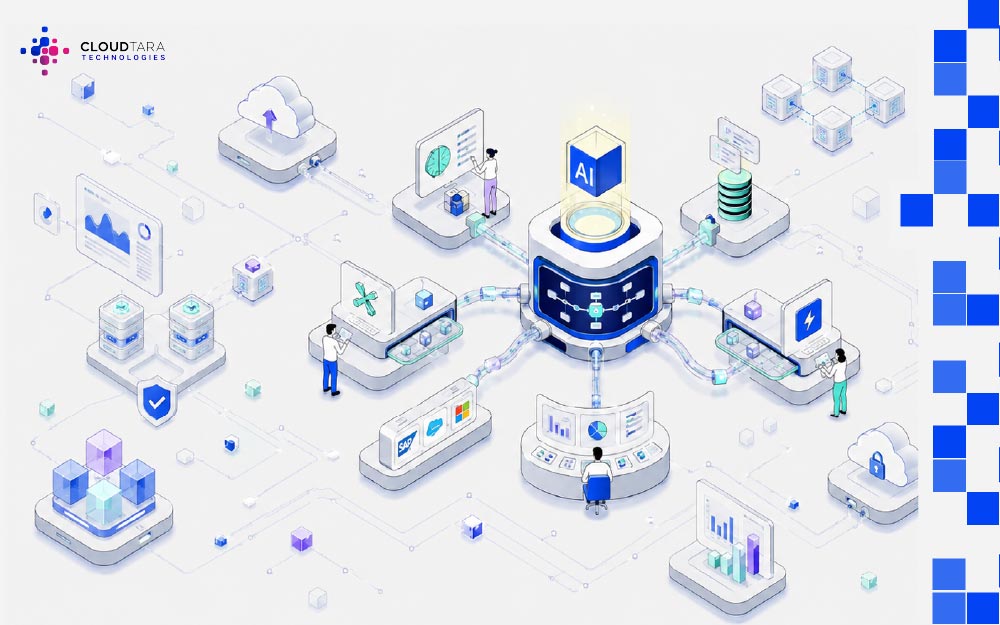
The AI infrastructure for health care employed in hospitals helps to determine whether processes are ready to move from the control stage and become automatized. It connects systems of data and computing resources, operational support and safety measures used in the work.
CloudTara brings AI strategy, engineering and enterprise integration together to support healthcare AI initiatives. Its workflow-focused approach starts with what needs to improve and the technical foundations required to support that change.
The process of making a decision concerning the purchasing of a product should take into account all the factors connected with its operation and availability in the long run.
What is included into AI infrastructure?
AI infrastructure includes the technology and operational capabilities required to build, deploy, monitor and maintain AI applications.
In healthcare, these capabilities must accommodate sensitive information, fragmented systems and workflows where errors can have significant consequences.
Enterprise AI infrastructure requires multiple elements to perform their functions effectively. Increased computing power won't change mismatched patients. A good model also cannot offer up-to-date updates to enable the integration process.
Automatic upgrades will help avoid major failures in the system.
Start From a Process and a Defined Result
The business task of AI in healthcare becomes less confusing if the issue is clear.
Referral input, documentation support, appointment organization, and claim preparation require different types of data, users, and results. They should never be implemented with one approach.
For example, in case of referral input a piece of software extracts data, finds missing papers and proposes a way of operations. In order to bring benefits, the application should also be able to deal with repeated requests, wrong patient matching, and inaccessible receiving systems.
Before purchasing, it is important to define:
- The current bottleneck and the performance level.
- The data necessary for task completion.
- The software required for the data transfer.
- The abilities of AI.
- The situations that need human intervention.
- This process should be measured throughout the whole speed duration.
Evaluate the result across the total process. Quicker extraction is important when it allows referrals to reach the target group as soon as possible, without delays or any re-processing.
Make a distinction between administrative automation and solutions related to clinical decisions. Each of these requires a specific assessment in terms of validation, monitoring and regulatory needs.
Create a Data Infrastructure That Shows Uncertainty
- Verify Quality Before Use
AI in healthcare can be effective in providing a competent answer from incomplete data. Infrastructure should demonstrate inability.
Verify that information is up-to-date, fields are approved and patient identity is validated. Care for duplicates, differences in terminology and misinformation.
If the need for key input is insurmountable, this should launch either a request or referral for clarification.
Good results should not cover absent proof.
- Retain Sources and Context
Users must know the origin of a result.
In terms of summaries and documents retrieval, maintain references, dates and versions of documents. Keep clear distinction between the output and original records and approved modifications.
This helps with both the review process and makes it easier to conduct investigating incidents.
In the case of AI in health care, traceability plays an important role, especially when different departments use the same information for different purposes.
- Regulate Data Transfers
Don't just transfer data to a new system for the sake of having it.
Instead, focus on what the application needs to query, synchronize or keep. Make sure that temporary files, backup files and monitoring logs are all included.
Creating copies brings along implications in terms of access, retention and maintenance.
Consider Integrating as A Requirement to Purchase
Software that needs frequent exporting, uploading and copying is likely to complicate the workflow.
It is essential to confirm how data will be transferred from the application to a provider.
If we look at FHIR, we see a standard that allows for health information exchange via an API interface. Yet, you still need to check what functions the system is able to perform.
Confirm Data Transfers
Ask vendors to demonstrate:
- Which records and fields can be accessed
- Whether access is read-only or can also be used to update it
- How authentication and permissions function
- How fast changes become available
- What happens when a request fails
Saying that the product “integrates with your EHR” raises several questions.
Design for Partial Failure
These operational details are central to enterprise AI infrastructure for healthcare, particularly when workflows cross several platforms.
The workflow should be designed to keep the request in the system, so that it can be resubmitted without duplicates, and inform someone responsible to take action. Determine your retry rules, reconciliation mechanism, and escalation steps before you launch it.
These operations force us to think about the infrastructure of AI in healthcare.
Choose Deployment Based on the Workload
Ideally, the choice around the infrastructure components should be based on workload needs rather than on the preference for a certain hosting model.
For instance, the background document queue can afford to have delays in the results. In contrast, the application, which goes during an appointment, should ensure fast responses. Imaging applications can require different processing and storage conditions.
Evaluate expected volume, peak demand, response times, connectivity and recovery requirements.
Choosing Between Managed Services and Self-Hosting
When using managed services, you can lessen infrastructure management responsibilities. However, you will still need to consider technical aspects such as data management practices, availability of services, operational changes and costs of operation.
Although self-hosted solutions offer more freedom of deployment, they increase responsibility in terms of scaling, maintenance, security and assessment.
Remember to analyse true operating costs that include people responsible for maintaining the service.
Choosing Between Cloud, On-Premises and Hybrid Solutions
The right solution will depend on architecture, data characteristics, internal capacities and requirements.
Hybrid solutions may help tackle certain issues, but at the same time they introduce more dependencies and connections.
Be sure to ask your service provider how the proposed components will help deliver the solution and how the solution will deal with dependencies.
Make Security and Governance Part of the Design
AI in healthcare should be designed in accordance with data management requirements – from data collection and processing to storage and output.
Controlling Access Throughout the Process
Control access of users and applications. Service accounts should be able to perform only necessary operations.
Test if data access complies with permissions given to users and also whether automated actions remain within approved boundaries.
Include logs and the tools used for the support. Storing full prompts and responses could contain private information and complying with the basic system protections might not protect the data in full.
Evaluate Contracts and Configuration at the Same Time
According to the United States HIPAA regulations, government agency administration states that providers use services for the electronic protected health information of the entities, numerous business associate agreements need to be in place. Organizations have to conduct the risk analysis that satisfies HIPAA rules. Merely signing a document is not enough to ensure compliance with the deployment.
Identify the actual procedures, data flows, terms for data preservation, and responsibilities. Organizations that operate in other territories need to comply with their certain requirements.
Determine Who Is Responsible for Approval and Blocking of the Service
There should be a person accountable for service approval, major changes, and action in emergencies or emergencies.
Changing models, prompts, data sources, etc. can enhance the procedures.
Scaling AI in Healthcare Efficiently
The practical answer to how to scale AI in healthcare is to prove one workflow while creating foundations that other approved use cases can reuse
With the help of its AI strategy and product engineering services, CloudTara makes it possible to connect the chosen pilot project with the systems and operational processes required for further scaling.
1. Define Requirement Specification for the Production Stage
Determine the necessary quality of output, turn-around-time, and integration level before proceeding with the launch.
Conduct tests both on complex records and standard situations.
2. Start from a Narrow Scope
Begin the project with a certain team, location or process area. Make sure the fallback option is in place before the actual go-live.
Extend the scope only when formal evidence is available.
3. Make Use of Already Existing Components
Make sure the identity integration process, access control and monitoring system are standardized.
Keep different requirements separate for different use cases.
4. Allocate Continuous Accountability
Identify the owner of the business, owner of technology and group responsible for assistance. Be sure to allocate the money for assessment, support and response to issues.
For executives who are trying to find perfect approach to scale AI in healthcare industry the responsibilities are equally important as the initial architecture. Increase of the number of users means that somebody should provide support for this.
Assess the Economics of the Whole Workflow
Low cost of one request of the model can hide the high cost of some service.
Be sure to include data preparation, integration, services, human verification, assistance and amending in the business case.
Monitor costs of successful workflows taken together with the time spent, amount of corrections and the number of employees’ time spent.
In referral processing it is important to know whether the referral goes to the right team with minimum number of actions taken. Simple and speedy task does not mean that process is improved.
Check whether the economics of operation are valid during the peak time of demand. If it takes too much time to verify each output the costs change drastically.
Released staff capacity should also have a defined purpose, such as reducing backlog, improving service or absorbing additional demand.
Questions to Ask Vendors
Before committing to a vendor, be sure to ask them the following questions:
- What are the potential gaps that may prevent your deployment?
- What changes should be made to your existing systems?
- How will access and usability be tested?
- What happens if a model doesn’t work?
- Who will own future changes and support?
- What documentation and operational knowledge will be gained?
Also expect dependencies, accountability and acceptance criteria. What happens when you run a demonstration, such as handover and costs?
Create Dependable Infrastructure for Your Healthcare Teams
Using AI responsibly is dependent on good data access, seamless integration, and clear accountability.
CloudTara can deliver the answers by introducing you to the combination of AI products, engineering, modernization, and support. Its approach aims at aligning process with technology and will help healthcare organizations planning implementation based on existing systems, expert opinions, and operational requirements.
Looking for the right AI solutions for healthcare? Schedule a consultation with CloudTara to find out more about your required process and integration solutions and their availability.