The AI pilot performs its function. On the other hand, the decision to produce is on hold.
An enterprise AI operating model defines who owns AI initiatives, how teams deliver them and what governance is needed to keep them running reliably.
Operations wants to implement the new model: IT requires an Integration Plan, Security does not know who has access to data, Finance asks about who will pay for the system upkeep. No one is certain who is in charge of approving the launch of the system or stopping it in case of an emergency.
AI operational models provide answers to these challenges before they shift to the delivery stage. They provide definitions for such questions as how a company selects, develops, manages, and conducts its operations with the new AI operations model with clear delegation of responsibilities among business and IT teams.
At CloudTara, the concept of AI workflow transformation is introducing the connection between those who make decisions on technology and those who actually do their work.
Importance of Operational Model of Artificial Intelligence
AI operating model establishes critical workstreams, needful for running AI in the organization.
AI operating model should provide an answer on:
- Where to invest from the business standpoint.
- Who will be responsible for execution and results obtained.
- What information should be collected for making decisions.
- How to take care of arising issues or changes.
- When to upgrade, expand or terminate existing technologies.
Enterprise AI strategy determines where AI must be value-adding. Operating model specifies the way how this value is reached. AI governance establishes rules and procedures that has place to be within all the steps taken.
Everything has to be connected. A strategy without an execution responsible creates uncertainty. Governance without practical ways for approval makes life difficult. Abandonment of operational responsibility leads to implementation without anybody wanting to take over things.
Start the process with the Workflow Along With Its Owner
Understanding how to build an enterprise AI operating model starts with the workflow you want to improve and the person accountable for its performance.
Consider the AI app that assists with analyzing requests coming from clients and provides recommendations concerning next steps.
The right suggestions are not enough for the effective functioning of the app since it is required to retrieve data, solve potential problems and update information.
If the chosen app still requires workers to transfer data manually and validate it, it may not bring the expected return on investment.
Before adopting any technology, it is necessary to identify how the workflow functions, where it enters, stops and leaves. Analyze the points where delays occur, where human judgment is needed and which processes can be automated.
Next, designate a person in charge of the process. Only somebody authorized to initiate changes in the workflow and approve the pilot will be able to achieve the results.
Select the Right AI Team Structure
- Centralised: Concentrate Expertise
In this structure, all AI development is overseen by a central team that determines technical standards and sets deadlines.
This way, an organization with little specialist capacity can effectively set common bases for its work, but has a challenge in what concerns throughput – every division wants to attract the same resources.
In case it is important to integrate business owners at a certain stage, technical priorities can be aligned with business requirements.
- Federated: Share Standards, Distribute Ownership
In this organizational form, a central team develops all common strategies and platforms and business divisions implement their cases.
This structure is a good fit for an organization where several branches need this technology at the same time and can implement some general approaches.
It is very important to clearly stipulate which decisions can be made by the business units independently and which ones should be agreed upon with the central group. Otherwise there will be confusion with regards to the responsibilities of the participants of the process.
- Decentralisation: Allow Business Unit Independence
Business units maintain authority over their AI expenditures and teams handling execution.
This is applicable to independent divisions with prior technical expertise. However, it might give rise to unnecessary drug-dealing and disparate regulations.
Retain enterprise-wide guidelines with respect to data access, vendor reviews, inventory and incident documentation.
- Allocate responsibilities around actual decisions
You do not require a new department for every project. You need individuals who will be responsible for making decisions to keep it going.
One individual may assume different duties, but responsibilities must be clear. The delivery team should not be the only source for the evaluation of high-risk releases.
Consider using steering committees for any conflicts pertaining to investment or major exceptions. Regular decisions should involve some identified approvers, and decisions made need to be fully documented proved and coordinated.
Establishing Company AI Governance Framework
The AI governance framework for enterprises turns policies into concrete decisions across operations.
NIST GRM (Governance and Risk Management) offers a great source to refer to due to its functions that include Governance, Mapping, Measuring, and Management. Here is applied the principle of ongoing process of governance through the AI operational lifetime.
Translate this principle into four operational conditions.
- Risk Classification via Business Impact
For example, the tool that writes internal briefs has to be governed differently from the tool that makes changes to customer records, and initiates payments.
Take into account the sensitivity of the information, number of stakeholders involved, effects of decisions, autonomy of the system and how easy it will be to reverse actions. Use the information to decide on the risk testing scope, approval, and monitoring methods.
Establish Parameters for Ken Actions
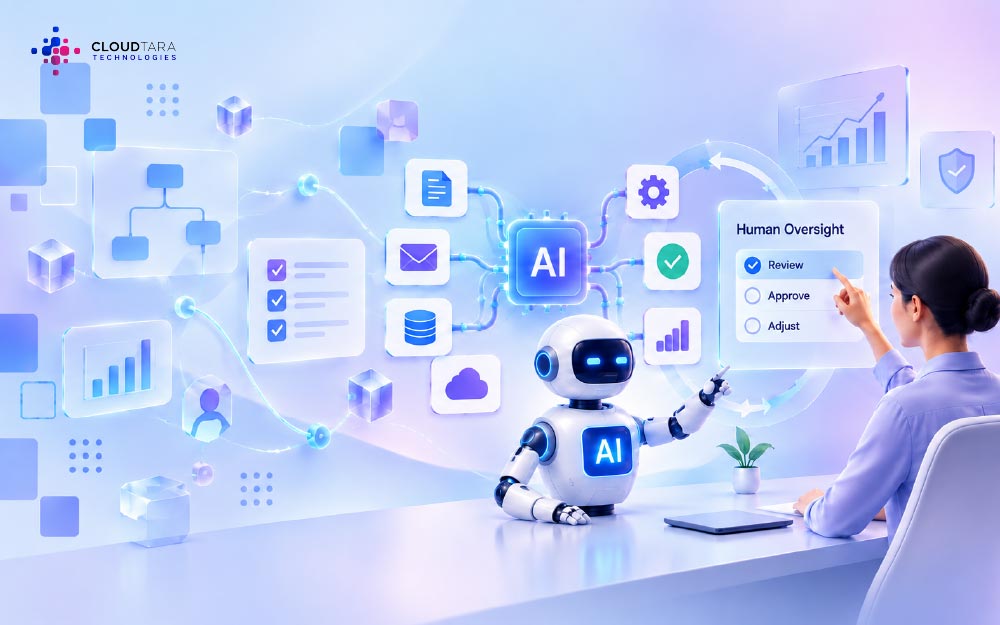
- "Human supervision" is too vague.
Clarify the type of actions needing approval, who is responsible for it, and the amount of information the approving person will receive. Specify what happens when certain data are absent or when a proposal is beyond the scope of approval.
Example: for instance, the app prepares updates for suppliers but needs an authorized person to approve changing payment information.
Ensure the border management by means of permissions and workflows.
- Reach a Consensus on the Evidence of Release
The business, engineering, and risk teams should set up the acceptance criteria before the development starts.
The evidence may include fulfillment criteria, case handling, tests of access rights, integration reliability, and acceptance testing.
Don’t forget to test recovery. If an application fails, the teams should understand the roles of everyone in the recovery process.
- Establish Knowledge Needs for Changes
Modifications of models, prompts, data sources, permissions, and tools can improve the performance of the system.
Save the data about versions and determine changes that require retest. Don’t forget to include the vendor adjustments if they affect the operational service.
Create a unique reporting channel for specialists and let the owner deal with incidents.
How to Create an Enterprise AI Operating Framework
When it comes to developing an enterprise AI operating framework, organizational leaders have to kick-start the initiative from practically one strategic workflow that can be measured in terms of its outcomes.
CloudTara provides the necessary help in deciding on strategic AI, engineering and integration, hence starting with the workflow itself and finding ways to use AI and ensure its sustainable operation.
1. Identify the Baseline
Prior to employing AI in handling business processes, you have to measure such indicators as turnaround time, effort and rework, backlog and operational costs per completed task.
A quick task completion is not the same as a quick process. For instance, when there are delays in approvals, the automation of document preparation may not lead to any recommended outcomes.
Select those indicators that will give assessments regarding the entire workflow.
2. Identify Ownership and Scope
Identify product and business ownership as well as the ownership of services. You should also specify the actions allowed and those not allowed for the parties involved, dependencies, escalation schemes and success criteria.
Agree on what the pilot must prove and what would justify stopping it. This makes the investment decision clearer when results arrive.
3. Determine What to Purchase, Create, and Connect
Examine the capabilities of the system before implementing a custom solution.
Compare each option for workflow needs, security measures, integration demands, total cost and possibility of switching vendors in the future.
Sometimes an existing product will cover a routine task while custom software targets specialized decisions or connections to older technology. Choose among your options in light of your business needs and maintenance costs.
4. Budget for Ongoing Operations
When creating a business case, involve software usage, hardware, monitoring of the level of human interference and support.
Appoint a production budget owner for the implementation period. Even a pilot project must ensure continued operation after deployment.
5. Launch on a Small Scale
Start with a certain group of users, a process and several actions.
Look at the obtained results together with quality, incidents and feedback from workers. Extend your project when there is evidence of its effectiveness.
Inquire about how your team will handle the solution once the engagement is over. Access to documentation, adjustments, evaluation resources and knowledge related to the operations should be secured before the delivery process begins.
Implement The Right Ownership Structure For Your Next AI Investment.
When evaluating how to build an enterprise AI operating model, ask prospective partners to explain how their delivery approach will fit your teams, approval processes and support requirements.
Having a successful AI operating model helps simplify several decisions: what to finance, who can approve it, how to determine the readiness level and who will be responsible once the project has been launched.
Begin the process with the right workflow. Grant authority for it to the person in charge. Involve the delivery and governance teams at an early stage. Provide funding for the support needed in the future.
CloudTara assists companies in bridging the gap between their AI plans and the implementation of those plans in production through engineering and integration support.
The organization’s approach allows the establishment of operating needs and defining responsibilities through the lens of workflow.
Combining identification of new opportunities with the modernization of companies’ existing systems, CloudTara enables the successful integration of new capabilities into existing workflows.
As a result, the model of AI operations can be applied in organizations in which technology decisions are made based on their business priorities and involvement in the day-to-day processes.
Are you preparing your AI pilot to move to production? Schedule a consultation with CloudTara to discuss your workflow, responsibilities and delivery specifics in order to ensure the proper execution of the project.