Introducing an AI agent in banks has improved customer onboarding processes. The AI tool helps sift through numerous documents, find relevant information and prepare summaries of cases. Even so, bank employees still have to switch between various systems to ascertain the correctness of data, resolve discrepancies, and make requests for approval.
This is where AI in financial services becomes an infrastructure decision. At this point, AI goes beyond merely being a tool for financial services. In order to generate visible results, one needs to ensure reliable data access, integration with transaction processing systems, monitored execution, and ownership of processes.
CloudTara brings AI strategy, engineering and enterprise integration together to help businesses build AI infrastructure around their operational needs. Its workflow-focused approach connects technology decisions with the systems, handoffs and support required for production.
How AI Is Transforming Financial Services Infrastructure
Understanding how AI is transforming financial services starts with the work between systems.
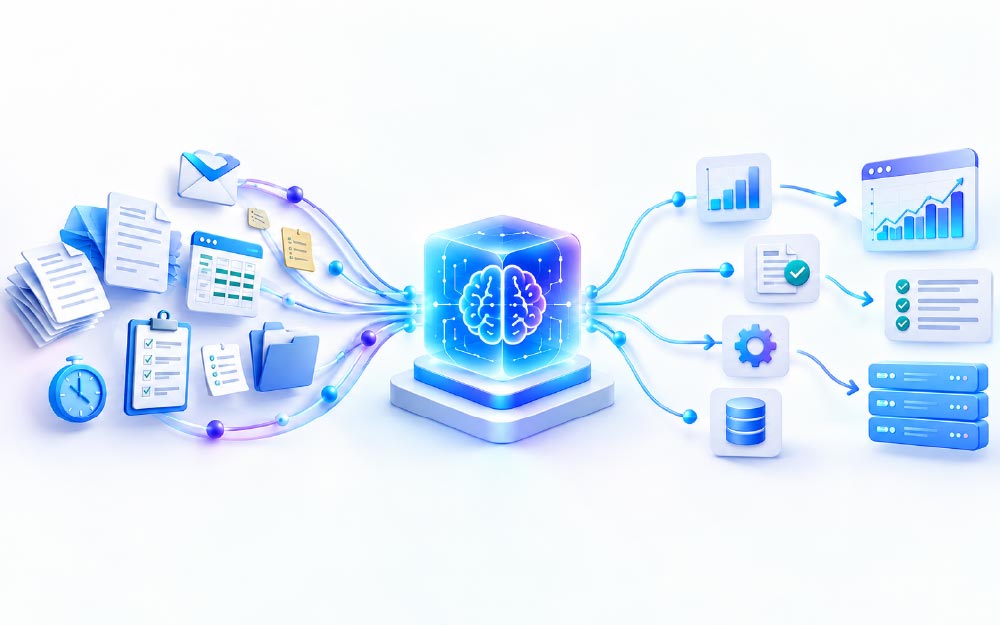
Banking institutions maintain structured records of the transactions along with emails, scanned files, policies, and notes. Most of the time manual understanding of those documents is made before giving a decision or updating some record on a different platform.
AI can be of great help when it comes to sorting documents, finding out the needed information, revealing patterns, and providing recommendations. It allows implementing its advantages in business processes, modifying the requirements to the infrastructure in use.
Applications have to provide permission-based access, trusted interfaces, evaluation methods, and monitoring in terms of both technical failure and bad results.
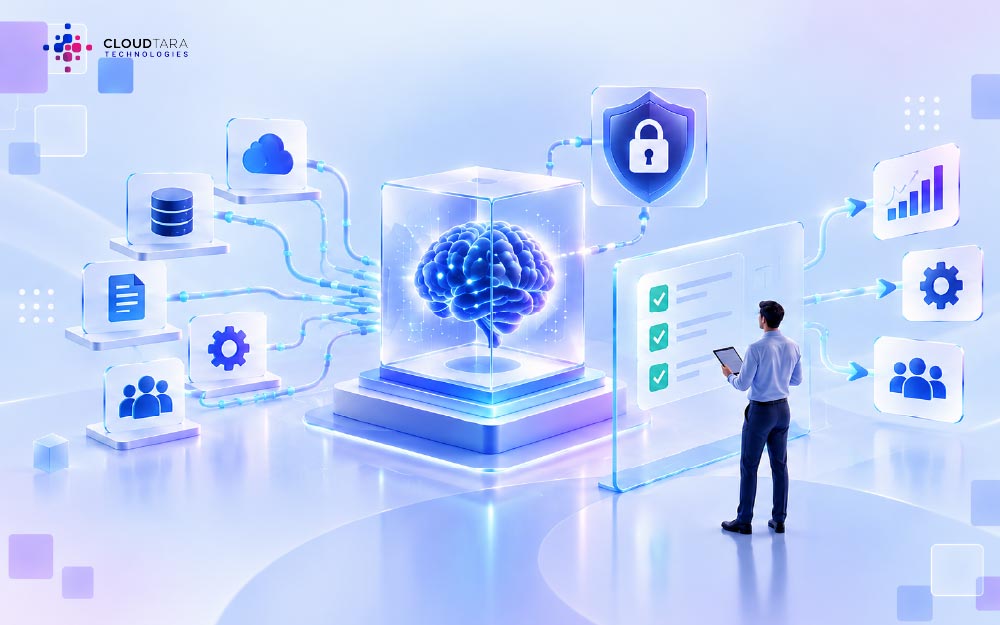
That is why Financial services AI needs architecture that will enable document interpretation and at the same time have strict control during execution. A recommendation and an action undertaken need different approvals.
Areas of Operations where AI can Improve Business Processes
The place to start is having phrases already defined with measurable friction and owner of the process.
- Customer Onboarding and Document Checking
AI can be applied for information extraction, completeness checking, and discrepancy finding.
The infrastructure should adjust the incoming documents to customer information, verification services, and investigation.
Investigation into Fraud and Alert Assessment
AI can assist in the process of prioritization of alerts or gather relevant account information into investigator's workspace.
An appropriate information system must provide the latest data, keep the history of investigations and facilitate the growth of investigations.
Assessment must take into account missed risks and redundant alerts. The increase in speed of processing does not matter when law enforcement agents receive more low quality investigations.
Reconciliation and Process Exceptions Handling
Using AI can assist in decoding inconsistent references and providing suggestions regarding which documents are similar.
Keep financial calculations and transactions under the control of validated process systems. Suggested matches must be supported by the proofs and it is important to arrange the approval for each with regard to the effect they have for processes.
Employee Knowledge and Customer Support
AI can search for approved policies in the system and assist in answering queries.
Across these workflows, AI in finance creates value when it reduces the effort required to complete an accepted outcome—not merely produce another output.
What AI Infrastructure for Financial Services Must Support
A production architecture needs several capabilities working together.
1. Data: Ensure consistent identities, quality checks, data freshness, and traceable sources.
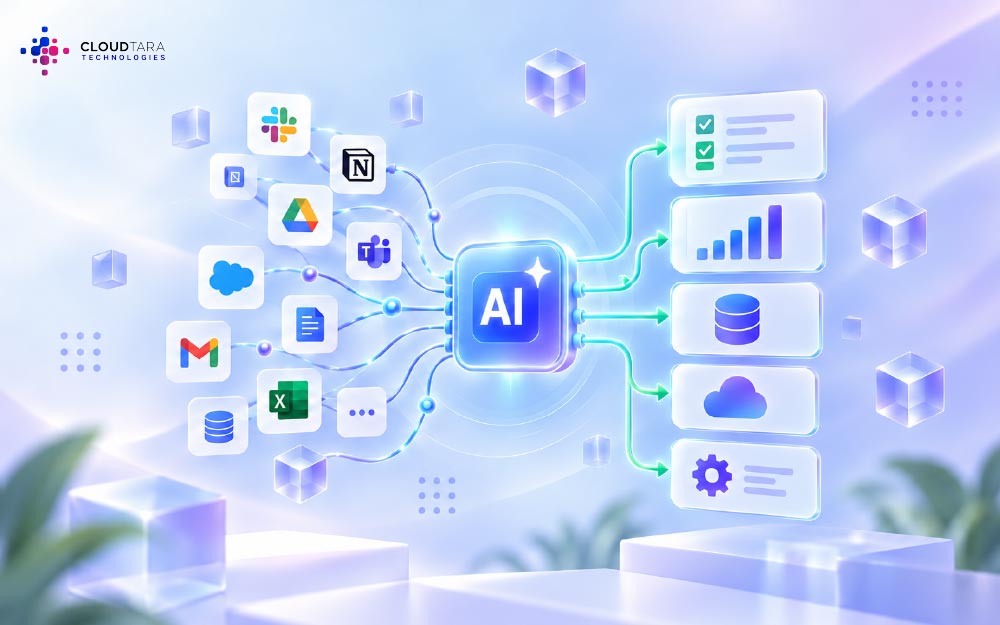
2. Integration: Enable reliable access to core systems, workflow platforms, and approved external services.
3. Model Execution: Maintain appropriate models, sufficient capacity, response times, and version control.
4. Security: Restrict unauthorized access, protect sensitive information, and control automated actions.
5. Evaluation: Conduct representative tests, define acceptance criteria, and include independent reviews where required.
6. Operations: Establish continuous monitoring, incident response, recovery processes, and clear ownership.
AI infrastructure for financial services should make dependencies visible before procurement. If a use case depends on data that arrives overnight, it cannot support a genuinely current decision simply by adding a faster model.
In a similar fashion, a technically viable interface could still fall short when it comes to the permissions and the volume of transactions necessary for the operation of a workflow.
Modernise Data Access While Avoiding the Creation of a New Silo
- Create a Uniform Perspective on Clients and Accounts
Similar clients, organisations or accounts may not always be classified in the same way in various systems.
Handle the issues of the identity mapping and ownership before record combination takes place. Each time, you are to declare how the system deals with contradiction discrepancies.
An application must disclose uncertainty rather than pick the easiest record randomly.
- Align Data Freshness to The Decision-Making Process
The timing aspect for application processing the information about the transaction is different for a transaction-monitoring application and a policy assistant.
Define the age of data that is acceptable to be used in specific cases. Keep track of delays and prevent old data from being treated as current.
The described situation should be taken into consideration when designing integrations.
- Keep Proofs and Protect Access
Preserve the data on the sources used and the time stamps where it is needed. Retrieval should enforce the user’s access rights before information reaches the model. Protect indexes, temporary files and logs as carefully as the original systems.
This makes financial services AI easier to investigate, maintain and trust within its intended scope.
- Linking AI to Main Systems Via Limited Interfaces
Modernisation does not necessarily call for outdated banking or financial network substitution.
The integration layer can promote selected opportunities while traditional systems continue to be accountable for the authentic transaction details and records.
The concept of enterprise modernisation, API integration and AI engineering coined by CloudTara is pertinent here. It makes it possible to determine how something can be reused, what requires adjustments and where customised development is needed.
- Keep Recommendations Apart from Their Implementation
The application may discover an anomaly, come up with a solution, suggest a revision.
However, the execution of the recommendation should be made using the permissions, approval steps and validation procedures pertinent to the recommendation type.
For instance, a system may suggest a customer record adjustment along with an authorization requirement for making the necessary changes in the payment instructions.
Do not rely on the suggestion alone for controlling the process, though.
- Plan for Partial Failure
If a case gets an approval, while the subsequent update is unsuccessful.
The workflow should hold on to the approved case, avoid any repeated execution and show the incomplete status of the case. The retry process should be determined.
Choosing the Right Mode of Deployment Based on Performance, Control and Cost
The AI infrastructure must be attuned to the specific workload rather than simply relying on a preferred model or environment.
While document processing may operate well under queues, interactive applications require faster response times, and transactional systems require low latency and high availability.
- Pros and Cons of Managed Services vs. Self-Hosting Solutions
Using managed services may ease the system administration burden, but it can create dependencies in terms of providers' availability and their update policies.
The self-hosted solutions are more flexible but require also more responsibilities regarding the maintenance, the security and the capacity planning.
Compare the real cost of the service, including the engineering, testing, and support expenses.
- Understand the Provider Dependencies
According to the Financial Stability Board, dependencies on third parties, cybersecurity, and model risks (data quality and governance) are the most significant AI-related threats that the financial sector should worry about.
Identify the service providers responsible for each crucial business process. Investigate the plans for recovery, alerting about modifications, and data transfer.
- Integrate Governance in Production
In order to understand in what ways AI is affecting financial services, it is essential that leaders evaluate the transformation of accountability along with automation.
Responses to the following queries need to be initiated before deployment.
- Use Cases Based on their Effects
An internal automating assistant would require a different level of governance than a project that will cause changes in credit scoring, fraud prevention and payment procedures.
Assess the visibility of the situation, data processing involved, self-sufficiency and the reversibility of decisions. Ensure that responsible specialists are involved in setting up the requirements.
- Test More than Just the Average Rate
Analyze exemplary cases, unusual situations, lack of data and low performance.
In the case of influencing customers’ decisions, assess the differences among groups and situations of people. Test whether the reviewers would be able to spot mistakes and whether explanations would help. A good sum can fail in generalized cases.
- Control Changes After the Launch
Change versions, instructions, source of information, rules and access rights.
Identify the changes that must be retested or approved only on a particular stage. Governance needs to remain connected to the running service.
Use the One Process and Expand It Using Reusable Foundations
Building AI infrastructure for financial services around reusable integrations, access controls and monitoring helps teams expand to new workflows without rebuilding the foundations for every project.
Establish success metrics before starting: time to complete, failure rates, quality, effort required to complete work and cost per successful job.
Design components for all stages of authentication, integration, logging, delivery and performance evaluation. Keep controls relevant to the use cases apart. This approach to building AI infrastructure in fintech allows following projects to leverage proven capabilities without assuming that applications have similar risk profiles.
Before expanding, confirm that support team is ready to respond to problems and users know fallback options. Even a successful pilot should come with a budget and manager.
Assess the Value of Completion Workflow After Evaluating, Redesigning and Supporting It
A cheap cost of model deployment is not enough to justify the business case. Consider integration process, data preparation, human review, monitoring, support and vendor costs. Calculate the total cost of a successfully completed workflow.
For onboarding, keep track of the elapsed time and customer dropouts in addition to the effort of the team. For investigations, analyze the cases' quality and the workload of investigators. In reconciliation, analyze unmatched cases and reconciled records.
To obtain more funding in fintech and other financial services through operation evidence, information about the processes must prove that faster processing means that more verification is needed at the later stages. Adjustments to the workflow are required, and only after this can the company scale itself up.
Creating a Practical Disconnect Between Investment in AI and Automation
The financial success of AI depends on the infrastructure of its implementation and responsibilities connected to it. A proper setup of data, integration and processes will result in a capability, which will turn into a reliable service.
CloudTara combines AI strategy, product engineering, enterprise integration and ability support. Such an approach allows developing a good starting point for financial institutions to understand dependencies in terms of offer delivery and planning this delivery process.The value of AI depends on the infrastructure and responsibilities surrounding it. Reliable data, controlled integration and operational support determine whether a useful capability becomes a dependable service.
Evaluating AI in finance? Book a consultation with CloudTara to discuss your priority workflow, infrastructure gaps and the requirements for moving into production.